Quick answer: start with the circuit, not the charger. If you are plugging into an existing NEMA 14-50 outlet, both units top out at the same 40A and the Grizzl-E Classic is the one to buy, because the money goes into a cast-aluminum NEMA 4 enclosure and a 3-year warranty instead of amps you cannot use. If you are paying an electrician for a new 60A hardwired circuit, or you want scheduling and energy readouts without leaving the mid price tier, the NexCyber Level 2 48A is the better fit.
The Case for Each Box
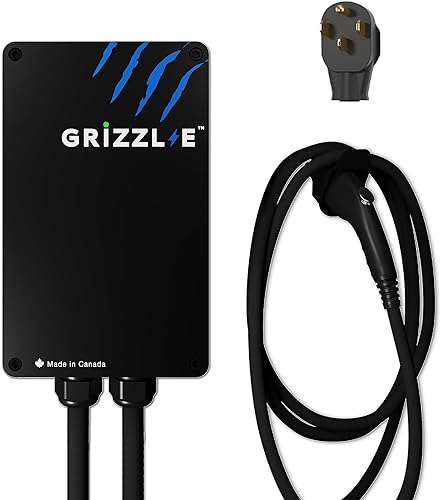
Grizzl-E Classic
A 40A J1772 charger with a 24-foot cable and a NEMA 14-50 plug, built into a cast-aluminum NEMA 4 enclosure rated for permanent outdoor mounting. Maximum current is set once with internal DIP switches across 16A, 24A, 32A and 40A, and there is no app, no account and no firmware in the path. It sits in the premium tier and holds a 4.6-star verified-buyer average. United Chargers backs it for 3 years.
See it on Amazon →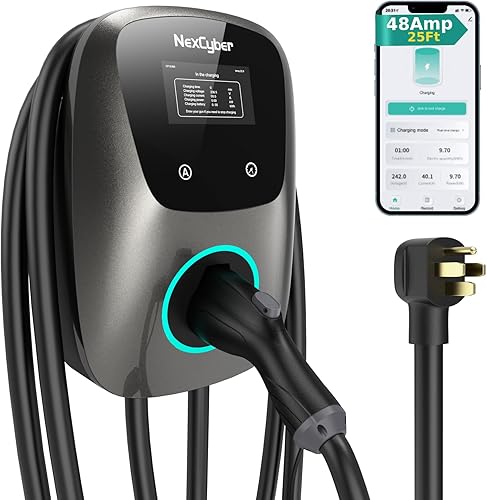
NexCyber Level 2 48A
An ETL-certified J1772 unit adjustable from 16A to 48A, with a 25-foot cable, a NEMA 14-50 plug, WiFi and an on-unit display for setting current without opening anything. It costs meaningfully less than the Grizzl-E and is the only one of the two that can use a 60A circuit. It is also a much newer listing from a much smaller company, so the support history behind it is thin.
Check it on Amazon →Eight Amps, One Enclosure, and the Warranty
Both units use the standard J1772 handle and both ship with a NEMA 14-50 plug, so they are physically interchangeable on the same 240V outlet. The Grizzl-E Classic specification comes from its maker, United Chargers; the 80 percent continuous-load limit that governs the amperage column is in NFPA 70, the National Electrical Code. Range figures assume a car that can accept everything the charger offers.
| Charger | Rated Max | On a 14-50 Outlet | Amperage Control | Enclosure | Cable | Warranty | Price | Link |
|---|---|---|---|---|---|---|---|---|
| Grizzl-E Classic | 40A | 40A (~30 mi/hr) | Internal DIP switches (16/24/32/40A) | Cast aluminum, NEMA 4 | 24 ft | 3 years | $$$$ | View |
| NexCyber Level 2 48A | 48A | 40A (~30 mi/hr) | On-unit display and WiFi app (16–48A) | IP65 / NEMA 3 | 25 ft | Check listing | $$$ | View |
Price tiers are approximate. $ = under $50, $$ = $50 to 150, $$$ = $150 to 300, $$$$ = over $300. Tap any link for the current Amazon price.
Where the 48A Rating Quietly Disappears
This is the part that decides the comparison, and the product titles hide it. A NEMA 14-50 receptacle is a 50A device, so it belongs on a 50A breaker. Code treats EV charging as a continuous load and caps a continuous load at 80 percent of the breaker rating, which lands at 40A. A charger rated to 48A, plugged into a 14-50 outlet, must therefore be configured down to 40A. The extra eight amps exist only on a 60A circuit, and since no ordinary household receptacle is rated for 60A, using them means a hardwired connection.
So the honest read of the spec sheets is this: if your garage already has a 14-50 outlet, you are choosing between two 40A chargers at different prices. If you are hiring an electrician anyway and the panel has room for a 60A breaker, the NexCyber can grow into it and the Grizzl-E Classic cannot. Our breaker-sizing guide for a 48A charger walks through the wire and breaker side of that upgrade, and the plug-in versus hardwire comparison covers what each connection method costs to install.
What the Extra Amps Are Worth in Range
At 240V, 40A is about 9.6 kW and 48A is about 11.5 kW. For a typical electric car that is roughly 30 miles of range per hour against roughly 35. Over an eight-hour overnight window the gap is about 40 miles, and most drivers never see it, because most cars sit plugged in far longer than they need. Two cases make it real: a long highway commute in a heavy vehicle, and a household feeding two EVs from one charger on a rotation.
There is a second ceiling that overrides both chargers. The car's onboard charger sets the maximum it will accept, and plenty of popular models cap at 7.2 kW or 11 kW regardless of what the wall offers. A car with an 11 kW ceiling cannot use 48A at all. Checking that figure in the owner's manual before buying is the cheapest step in this whole decision, and our amperage guide lists where the common ceilings sit.
A Touchscreen Against a Set of DIP Switches
The NexCyber carries WiFi, an app and an on-unit display, and the display is the part worth having: current is set by pressing a button rather than by opening the enclosure. Scheduling matters if your utility bills time-of-use rates and your car's own timer is awkward to use. On a flat electricity rate, the app mostly gives you a kilowatt-hour readout.
The Grizzl-E Classic has no app at all, and United Chargers treats that as the feature. Current is set with DIP switches inside the enclosure across 16A, 24A, 32A and 40A, which means a screwdriver and, ideally, a decision made before the unit goes on the wall. The upside is durability of a different kind: a charger with no account cannot lose a server, cannot be stranded by a discontinued app, and cannot change behavior after a firmware push. If you want the connected options in the same output band ranked, our 48A charger roundup covers them.
What Buyers Keep Saying About Each
Verified-buyer themes split cleanly along brand age. Grizzl-E buyers describe a heavy, cold-tolerant unit that is dull in the best sense, and the recurring complaint is the DIP-switch adjustment, which several report discovering only after the charger was mounted. Nobody describes an outage taking their charging offline, because there is no cloud in the path. Its 4.6-star verified-buyer average has been earned over several years on sale.
NexCyber feedback centers on the on-unit display and the amperage control, which buyers repeatedly credit with making a weaker circuit workable, and on the certification markings. One verified buyer describes replacing a failed name-brand charger with it and finding it fully up to daily duty. The caveat is structural rather than critical: it is a recent listing from a small company, so there is little long-term field data and no long warranty record to lean on. Weigh the rating accordingly.
Installation, and the Receptacle Nobody Budgets For
On an existing 14-50 outlet either charger is a same-day job with no electrician. On a new circuit the labor is nearly identical, and the cost driver is the run from the panel to the wall, not the charger on the end of it. The one asymmetry: a 60A hardwired circuit for the NexCyber needs heavier conductors than a 50A circuit, so the wire cost rises with the distance.
Here is the trade-off that gets left out of product copy. In a plug-in setup the receptacle is the wear item, and the cheap 14-50 outlets sold for occasional RV use are the ones that develop loose or discolored contacts under a nightly plug cycle. Both of these chargers are heavy enough that their weight hangs partly on the cord if the unit is mounted badly, which pulls on those same contacts. Mount the box on the wall properly, dress the cord so nothing hangs from the plug, and spend the extra on an industrial-grade receptacle. A hot outlet behind a working charger is the most common failure in this category, and it is not a charger failure at all. Our guide to chargers that keep tripping a breaker covers how that shows up.
Which One Belongs on Your Wall
Buy the Grizzl-E Classic if the charger has a permanent home, especially an exterior wall, and if your circuit is already a 14-50. The cast-aluminum NEMA 4 enclosure, the 3-year warranty and the multi-year track record are what the extra money buys, and on that outlet it is not slower than the alternative by a single amp. Set the DIP switches before you mount it.
Buy the NexCyber Level 2 48A if you are running a new circuit and want the 48A headroom, if you want scheduling and a display without leaving the mid price tier, or if the budget simply will not stretch to the Grizzl-E. Accept the trade honestly: a newer brand, a lighter enclosure better suited to a garage than an exposed wall, and a warranty you should read on the listing rather than assume. For the broader budget field, our under-300 roundup ranks it against the rest.
Where it is genuinely close: a sheltered garage, one car with an 11 kW or lower ceiling, and an outlet already in place. There the NexCyber does the identical overnight job for less. Where it is not close: an outdoor install in a cold or salty climate, where the aluminum case is worth paying for, or a 2022-or-newer car on a fresh 60A circuit, where only the NexCyber can use the capacity.
FAQ
How This Pair Was Checked
Each unit's amperage range, connector, enclosure rating, cable length, certification and adjustment method was taken from the manufacturer's published documentation and the product listing specifications, then checked against the recurring themes in verified-buyer reviews for anything a spec sheet gets wrong in practice. The amperage figures in the table are derived from the 80 percent continuous-load rule in NFPA 70 rather than from marketing copy, which is why both chargers show the same number on a 14-50 outlet. Price positions were recorded as durable tiers on 2026-11-02 instead of figures that go stale in a week, and no star rating is printed for a listing we could not confirm.
Neither charger was supplied by its maker and no manufacturer pays for placement here. Where a claim could not be confirmed against a published specification, the table says to check the listing rather than guessing a yes or a no.
Prices and availability reflect Amazon listings at time of writing. Confirm on the product page before purchase.