Quick answer: decide first whether the charger ever has to move. If it is going on one wall and staying there, the Grizzl-E Classic is the better buy: 40A through a cast-aluminum NEMA 4 enclosure, amperage set once with internal DIP switches, nothing to log into. If it has to ride in the trunk, follow you to a rental, or fall back on a 120V outlet away from home, the bokman Portable 32A is the one, and what you give up is roughly five miles of range per hour.
Verdicts for a Fixed Wall and a Moving Trunk
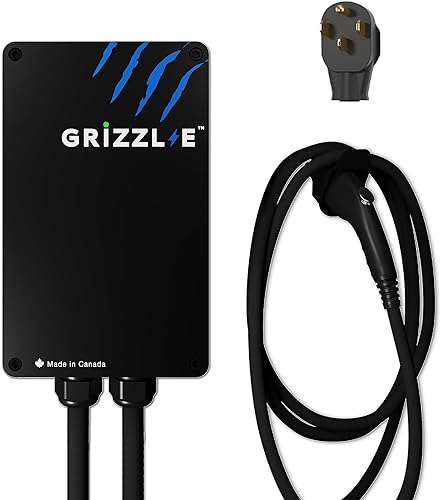
Grizzl-E Classic
A 40A J1772 charger with a 24-foot cable and a NEMA 14-50 plug, wrapped in a cast-aluminum NEMA 4 enclosure. There is no app and no account, which is the point: amperage is set with internal DIP switches across 16A, 24A, 32A and 40A, and after that it is a box on a wall. It sits in the premium tier, and it holds a 4.6-star verified-buyer average.
See it on Amazon →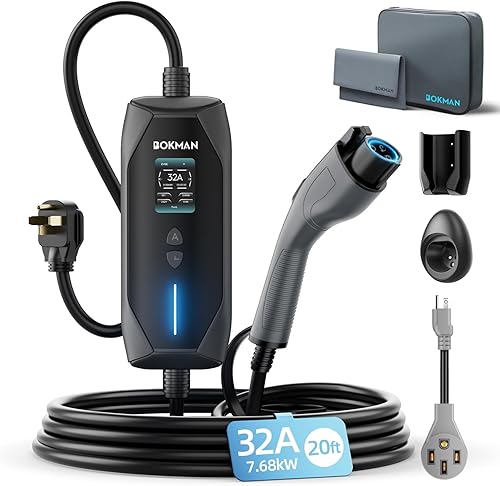
bokman Portable 32A
Dual-voltage (120V or 240V), adjustable from 6A to 32A with buttons on the unit, a 20-foot cord, and an IP65 rating. It costs meaningfully less than the Grizzl-E and gives up about a fifth of the charging rate for it, plus the option of charging anywhere there is an outlet. It holds a 4.7-star verified-buyer average.
Check it on Amazon →Side by Side on the Specs That Decide It
Both units terminate in the standard J1772 connector and both ship with a NEMA 14-50 plug, so they are interchangeable on the same 240V outlet. The spec sheet for the Grizzl-E Classic is published by its maker, United Chargers, and the range figures below assume a car that can accept everything the charger offers.
| Charger | Max Amps | Range Added | Amperage Control | Enclosure | Cable | Portable | Price | Link |
|---|---|---|---|---|---|---|---|---|
| Grizzl-E Classic | 40A | ~30 mi/hr | Internal DIP switches (16/24/32/40A) | Cast aluminum, NEMA 4 | 24 ft | Wall-mount only | $$$$ | View |
| bokman Portable 32A | 32A | ~25 mi/hr | Buttons on the unit (6–32A) | IP65 | 20 ft | Yes | $$$ | View |
Price tiers are approximate. $ = under $50, $$ = $50 to 150, $$$ = $150 to 300, $$$$ = over $300. Tap any link for the current Amazon price.
Where the Two Owner Experiences Diverge
The themes in verified-buyer reviews split along the same line the products do. Grizzl-E buyers talk about the enclosure and the absence of software: the unit is described as heavy, cold-tolerant and dull in the best sense, and the recurring complaint is the DIP-switch adjustment, which several buyers describe discovering only after the charger was already on the wall. Nobody reports a cloud outage taking their charging offline, because there is no cloud to go down.
bokman buyers consistently describe the opposite experience. The on-unit display and amperage buttons come up repeatedly as the thing that made a weak circuit workable, and the dual-voltage capability shows up in reviews from renters and from drivers who keep it in the car as insurance. The recurring criticism is the cord: at 20 feet it is shorter than the Grizzl-E's, and buyers who park nose-out in a deep garage mention running short. Its 4.7-star average is a touch higher than the Grizzl-E's 4.6, though the Grizzl-E has been on sale far longer.
Two Chargers, One Outlet, Different Jobs
Nothing about either unit changes what your car will accept. A Level 2 charger is a switch and a safety controller; the actual conversion happens inside the car, and the car's onboard charger sets the ceiling. If your car tops out at 7.2 kW, as plenty of 2017 to 2021 models do, the Grizzl-E's extra 8 amps buy you nothing and the bokman is simply the cheaper way to reach the same speed. Our guide to charger amperage walks through where each car's ceiling sits.
Where they genuinely differ is permanence. The Grizzl-E Classic is a plug-in unit, but it is built like a hardwired one: cast aluminum, mounting bracket, a cable long enough to reach around a car. The bokman is built to be carried, which means a lighter shell, a shorter cord, and the ability to drop down to a 120V outlet at a relative's house. If you are weighing the plug-in versus permanent decision more broadly, our NEMA 14-50 versus hardwire comparison covers the code and resale side of it.
The 32A to 40A Gap in Real Numbers
At 240V, 32 amps is about 7.7 kW and 40 amps is about 9.6 kW. For a typical electric car that is roughly 25 miles of range per hour against roughly 30. Across an eight-hour overnight window the difference is around 40 miles of range, which almost never matters, because almost nobody drives their battery flat on a weekday. It starts to matter in two situations: a long commute in a big, inefficient vehicle, and a two-car household sharing one charger on a schedule.
The bokman's 120V mode is a different story. On a household outlet a Level 1 charge adds something like three to five miles of range per hour, so a full overnight stint covers a short commute and not much more. Treat it as a way to avoid being stranded rather than a charging plan. The independent teardown-style review of the Grizzl-E at InsideEVs makes the same point about fixed 40A units in reverse: the speed is there whether you need it or not.
Neither One Has an App, for Different Reasons
This is a comparison with no WiFi on either side, which narrows what "smart" can mean. The Grizzl-E Classic is app-free by design and sets its current with DIP switches inside the enclosure. The bokman has no app either, but it puts a display and physical buttons on the unit, so changing the draw is a matter of pressing a button rather than finding an Allen key. If you want scheduling, energy reporting or utility rate integration, neither of these is the charger for it, and our roundup of 32A chargers covers the connected units in the same output band.
There is a real argument for the no-app approach that goes beyond saving money. A charger with no account cannot lose access to a server, cannot be orphaned by a discontinued app, and cannot push a firmware update that changes behavior overnight. Both of these units will still work exactly as they do today in ten years, which is not something you can say about every connected charger sold in 2020.
Installation, and the Part People Underrate
Both units land on the same circuit. A continuous 32A load belongs on a 40A breaker and a continuous 40A load belongs on a 50A breaker, because electrical code caps a continuous load at 80 percent of the breaker rating. Since both ship with NEMA 14-50 plugs, the normal answer is a 50A circuit feeding a 14-50 receptacle, with the bokman simply drawing less from it. If you already have that outlet, either charger is a same-day job with no electrician involved.
Here is the trade-off nobody mentions in the product copy: a receptacle is the wear item in a plug-in setup, and the portable use case is the one that wears it. A NEMA 14-50 outlet is built for occasional connection, not a nightly plug-and-unplug cycle, and the cheap ones sold for RV use are the first to develop loose or discolored contacts under that treatment. If you buy the bokman specifically to move it around, spend the extra on an industrial-grade receptacle and check it for heat discoloration every few months. If you buy the Grizzl-E and leave it plugged in permanently, the outlet sees exactly one insertion and this stops being a concern.
Which One to Buy
Buy the Grizzl-E Classic if the charger has a permanent home, especially an exterior wall. The cast-aluminum NEMA 4 enclosure and the longer cable are what the extra money buys, and the 40A ceiling means the charger will not be the limiting factor when you replace the car with something that charges faster. Set the DIP switches before you mount it, not after.
Buy the bokman Portable 32A if you rent, expect to move, share a driveway, or want a charger that can come on a road trip. The amperage buttons also make it the easier unit to live with on an older or shared panel, where dialing down to 24A or 16A is the difference between charging and nuisance tripping. Our portable charger roundup has the alternatives if you want a longer cord in the same category.
Where it is close: a single-car household with an attached garage and a healthy 50A circuit. There the Grizzl-E's advantages are mostly durability you may never need, and the bokman does the same overnight job for less. Where it is not close: an outdoor install in a cold or salty climate, where the aluminum enclosure is worth paying for.
FAQ
How This Head-to-Head Was Put Together
Each unit's amperage range, connector, enclosure rating, cable length and adjustment method was taken from the manufacturer's own documentation and the product listing specifications, then checked against the recurring themes in verified-buyer reviews for anything the spec sheet gets wrong in practice. Range-per-hour figures are calculated from amperage at 240V rather than copied from marketing copy, and price positions are recorded as durable tiers on 2026-10-21 rather than figures that go stale within a week.
Neither charger was supplied by its maker and no manufacturer pays for placement here. Where a claim could not be confirmed against a published specification, it was left out rather than estimated.
Prices and availability reflect Amazon listings at time of writing. Confirm on the product page before purchase.