Quick answer: start with the circuit, not the charger. If the panel can spare 50A, or you want a wall unit that never waits on a router, wire in the Grizzl-E Classic and set its DIP switches once. Go with the ChargePoint Home Flex if you have a 60A circuit to give and want the extra 1.9 kW plus scheduling, session costs and voice control from the app.
Each One in a Paragraph
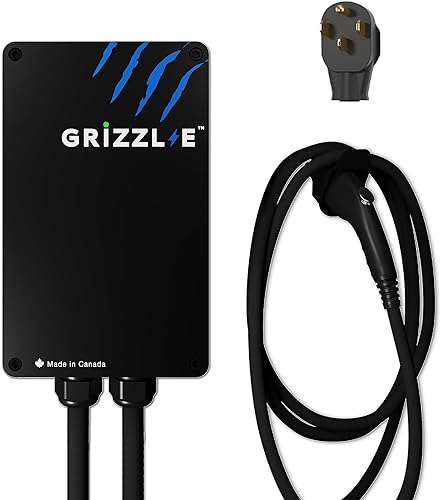
Grizzl-E Classic
A J1772 Level 2 unit rated 40A continuous, UL listed, in a metal NEMA Type 4 enclosure rated for -22F to 122F. Maximum current is picked once with DIP switches inside the case, so there is no pairing step, no firmware prompt, and nothing to re-authenticate after a router swap. It carries a 4.6-star verified-buyer average. Premium-tier pricing for hardware that does exactly one thing.
See it on Amazon →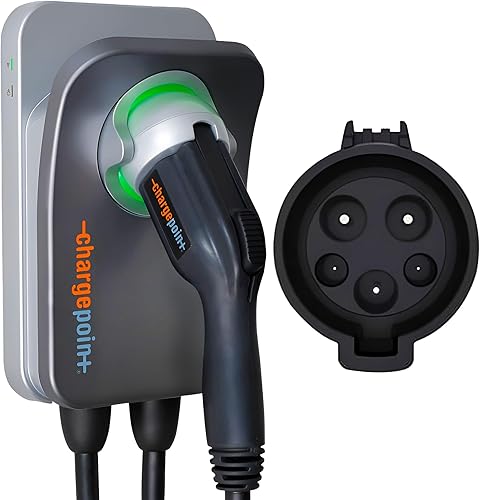
ChargePoint Home Flex
A J1772 charger that runs anywhere from 16A to 50A, set in the app rather than with a screwdriver, on about 23 feet of cable. WiFi, scheduling, per-session cost tracking and Alexa and Siri support are all built in, and ChargePoint publishes an Energy Star listing for it. The highest setting needs a hardwire install and a 60A circuit. Also premium tier, and the pricier of the two.
Check it on Amazon →Forty Amps vs Fifty, Line by Line
Both are J1772 Level 2 chargers on a 240V circuit and both sit in the same price tier, with the Home Flex the more expensive of the two. The cells below are the ones that actually decide the purchase.
| Charger | Max Current | Current Setting | Enclosure | Cable | Smart | Price | Link |
|---|---|---|---|---|---|---|---|
| Grizzl-E Classic | 40A continuous (about 9.6 kW) | Internal DIP switches | Metal, NEMA Type 4 | 18 ft or 24 ft by variant | None by design | $$$$ | View |
| ChargePoint Home Flex | 50A (about 11.5 kW) | 16A to 50A in the app | Polymer, NEMA Type 4 | About 23 ft | WiFi, app, Alexa, Siri | $$$$ | View |
Price tiers are approximate. $ = under $50, $$ = $50 to 150, $$$ = $150 to 300, $$$$ = over $300. Tap any link for the current Amazon price.
What 40A and 50A Actually Mean at Home
A charger's rating is a continuous draw, and the National Electrical Code requires the circuit feeding it to be sized at 125 percent of that. So a 40A charger wants a 50A breaker, and a 50A charger wants a 60A breaker. This is the sentence that decides most of these purchases, because the breaker is the part your panel either has room for or does not.
The second rule is the plug. A NEMA 14-50 receptacle is a 50A device, and a charger that plugs into one is limited to 40A continuous no matter what the box says it can do. That is why the Home Flex's 50A setting is only available on a hardwire install. Plug it into a 14-50 and you have, functionally, a 40A charger with a nicer app. If you are weighing those two install paths against each other, our breakdown of plug-in versus hardwired installs covers the code and resale angles in more depth.
Third, your car has a ceiling of its own. The onboard charger inside the vehicle sets the real limit, and plenty of EVs cap out at 7.2 kW or 9.6 kW. A 48A or 50A wall unit on a car with a 7.2 kW onboard charger charges at 7.2 kW. The extra capacity is not wasted exactly, since it carries over to your next car, but it does nothing today.
Charging Speed: 9.6 kW vs 11.5 kW
At 40A the Grizzl-E delivers about 9.6 kW, which lands near 30 miles of range per hour on a typical mid-size EV. The Home Flex at its full 50A delivers about 11.5 kW, closer to 37 miles per hour. Call it seven miles of range per hour of difference.
Across a nine-hour overnight window that gap is about 60 miles of range, which sounds like a lot until you notice that both chargers finished the job. If you drive 40 miles a day, either one refills that in under two hours. The 1.9 kW matters in exactly one pattern: you come home near empty, you have a few hours, and you leave again. Two-car households sharing one charger run into this more often than single-EV homes do, and so do people with long commutes in cold weather, where consumption climbs and charge acceptance drops.
The other thing worth sizing honestly is the panel. Going from a 50A to a 60A breaker is not a big jump in isolation, but in a 100A or 125A service it can be the difference between a clean install and a load calculation that pushes you toward a panel upgrade. If the 60A circuit is going to cost you four figures in electrical work, the faster charger has quietly become the much more expensive charger. Our guide to choosing between 16A, 32A, 40A and 48A walks through how to match the rating to the service you already have.
App, Scheduling and Voice Control
This is the real split. The Home Flex ships with WiFi, a mobile app, scheduling, session history and per-session cost tracking, and it works with Amazon Alexa and Apple Siri. If your utility charges time-of-use rates, the scheduler pays for itself by shifting charging into the off-peak window automatically, and the cost tracking turns that into a number you can actually read on a statement.
The Grizzl-E Classic has none of that, and the absence is a design decision rather than a cost-cutting one. It starts charging when the car is plugged in and stops when the car is full. There is no account, no firmware update cycle and no behavior change when the router is replaced. Owners who want scheduling on this hardware generally do it from the car's own app instead, which most modern EVs support and which keeps working regardless of what is on the wall.
Worth being precise here: app-free is true of the Classic specifically, not of the Grizzl-E line. The Classic Connect is the same rugged hardware with optional WiFi, and it is a different listing at a different price. We compare the two directly in Grizzl-E Classic vs Classic Connect if the app question is the one you are stuck on.
Plug-In, Hardwire and Circuit Sizing
The Grizzl-E Classic arrives as a plug-in unit, with a NEMA 14-50 or NEMA 6-50 plug depending on which variant you buy. Check that cell on the listing before you order, because the two plugs are not interchangeable and a 6-50 unit in front of a 14-50 outlet is an afternoon wasted. It can also be hardwired by an electrician if you prefer that route.
The Home Flex comes with a NEMA 14-50 plug and converts to hardwire, and as above, hardwiring is how you reach the 50A setting. ChargePoint's app walks you through picking the current limit during setup, which is genuinely useful when the electrician tells you what breaker they were able to fit and you have to live with that number.
Here is the install gotcha a spec sheet will not tell you: cable length is measured from the box, and the connector has to reach your car's port while still parking inside the garage door. On a J1772 car the port is usually front-left or front-right, so a charger mounted on the wrong wall can turn 23 feet of cable into a stretch. Before you drill, park the car where it normally sits, run a tape measure from the proposed mounting height to the charge port along the path the cable will actually hang, and add two feet for the droop. The Grizzl-E's 24-foot variant and the Home Flex's roughly 23 feet are close enough that mounting position, not the spec, decides whether the cable reaches.
One more longevity note from living with metal-cased chargers in a cold climate: the enclosure is only as weatherproof as the conduit entry below it. Both of these carry a NEMA Type 4 enclosure rating, and both will take years of rain on an exterior wall, but water tracking down a conduit run and into the bottom of the case is the failure I have actually seen. Drip loops and a bit of sealant at the entry cost nothing and matter more than the rating on the label.
What Buyers Report About Each Box
Verified buyers of the Grizzl-E Classic return again and again to the same theme: it is heavy, it feels industrial, and it keeps working in weather that bothers lighter units. The 4.6-star verified-buyer average reflects that. The recurring complaint is the opposite side of the same coin, that the cable is stiff in deep cold and takes a minute to coil neatly, and that setting amperage means opening the case rather than tapping a screen.
Home Flex owners talk most about the app. The scheduling and the per-session cost numbers come up as the features that changed their habits, and the Alexa and Siri integration gets mentioned as a convenience rather than a necessity. The common frustration is connectivity: a charger that depends on WiFi inherits whatever your garage WiFi is like, and a weak signal at the far end of the house shows up as sessions that do not log. Buyers who care about data generally end up adding a mesh node or an access point in the garage.
Pick One With a Single Question
Ask what breaker your panel can actually give you.
If the answer is 50A, buy the Grizzl-E Classic. You cannot use the Home Flex's advantage on that circuit anyway, and you would be paying the higher price for an app you could get from your car.
If the answer is 60A and you want the data, buy the Home Flex. The extra 1.9 kW is real, the time-of-use scheduling is worth money in most utility territories, and the adjustable range gives you somewhere to go if your electrical situation changes.
If the answer is 60A and you do not care about apps, buy the Grizzl-E Classic anyway and put the difference toward the install. A 40A charger on a 60A circuit runs cooler and leaves headroom, and the metal case is the part you will still be glad about in year eight. For a wider field at this rating, our roundup of 40A home chargers puts both of these next to the other options.
Common Questions
Is the ChargePoint Home Flex actually faster than the Grizzl-E Classic?
On paper yes, by about 1.9 kW. The Home Flex runs up to 50A on a 60A circuit for roughly 11.5 kW, while the Grizzl-E Classic is rated 40A continuous for about 9.6 kW. In practice the gap is close to 7 miles of range per hour, so an overnight charge lands at nearly the same state of charge. The difference only shows up if you regularly plug in with a nearly empty battery and leave again in under four hours.
Does the Grizzl-E Classic have a WiFi app?
No. The Grizzl-E Classic is the app-free model in the Grizzl-E line. Its maximum current is set with physical DIP switches inside the case at 16A, 24A, 32A or 40A, and the charger starts a session as soon as the vehicle is plugged in. If you want the Grizzl-E hardware with a phone app, that is the Classic Connect, a separate product with its own listing.
Can both chargers be hardwired instead of plugged in?
Both can. The Grizzl-E Classic ships as a plug-in unit with a NEMA 14-50 or NEMA 6-50 plug depending on the variant, and ChargePoint sells the Home Flex with a NEMA 14-50 plug that an electrician can convert to a hardwire install. Hardwiring is what unlocks the Home Flex's full 50A setting, because a plug-in charger on a NEMA 14-50 receptacle is limited to 40A continuous by code.
Which one holds up better outdoors?
Both carry a NEMA Type 4 enclosure rating, so both are built for rain, dust and snow on an exterior wall. The Grizzl-E uses a metal case and is rated for operation from -22F to 122F, which is why it turns up so often in cold-climate driveways. The Home Flex uses a polymer housing that is lighter and slimmer on the wall but feels less armored in the hand.
Do I need the adjustable amperage on the Home Flex?
Only if your circuit is uncertain or likely to change. The Home Flex is set in the app anywhere from 16A to 50A, which matters in an older panel where the electrician has to size the breaker around existing loads. The Grizzl-E Classic also steps down, to 32A, 24A or 16A, but you do it once with DIP switches rather than from a phone. If your circuit is already sized and will not move, neither adjustment range changes daily life.
How This Pair Was Compared
Both chargers were evaluated against their manufacturer documentation rather than marketing copy: the Grizzl-E Classic installation manual for its 40A continuous rating, DIP-switch current steps, NEMA Type 4 metal enclosure and -22F to 122F operating range, and ChargePoint's own specification and Energy Star listing for the Home Flex's 16A to 50A range, cable length and app features. Circuit-sizing claims come from the 125 percent continuous-load rule in the National Electrical Code, and the receptacle limit on NEMA 14-50 plug-in units.
Where a figure could not be confirmed against a primary source it was left out rather than estimated, which is why cable length for the Grizzl-E is given as the two variants the manual lists rather than a single number. Price tiers were checked on 2026-10-05 and are stated as brackets, not figures, because exact prices on these listings move. Nothing in this comparison is sponsored and neither manufacturer reviewed it.
Prices and availability reflect Amazon listings at time of writing. Confirm on the product page before purchase.