Quick answer: match the amp rating to what your car's onboard charger will actually accept, not the biggest number on the shelf. If it tops out around 32A, the bokman Portable 32A covers it without paying for headroom you cannot use. At the other end, a car that accepts a full 48A earns the hardwired Wallbox Pulsar Plus 48A and the 60A circuit it demands. The 40A middle tier has its own dedicated field; our 40A charger roundup ranks it product by product.
Which Amp Tier Wins for You

Wallbox Pulsar Plus 48A
Fixed 48A through a hardwired 60A circuit, with a NEMA Type 4 shell that shrugs off an outdoor mount. This is the top of the residential amperage ladder.
Check it on Amazon →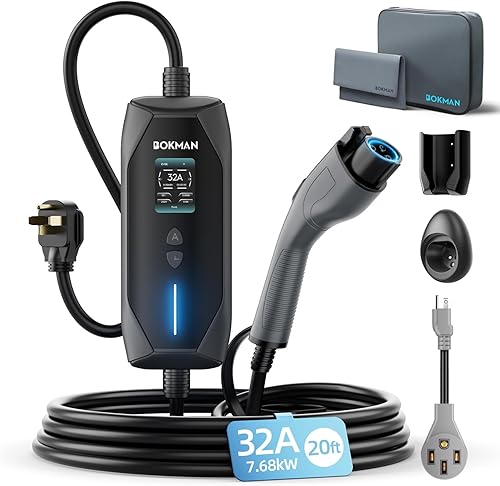
bokman Portable 32A
A true 32A unit small enough to travel with. The right call if your car's onboard charger never asks for more than 32A anyway.
Check price on Amazon →16A, 32A, 40A, and 48A Side by Side
16A is the baseline built into most portable Level 1/2 cords. The two chargers below bracket the tiers most home buyers actually shop, 32A at the entry and 48A at the ceiling; the 40A middle ground is ranked separately in our 40A roundup.
| Charger | Amps | Output | Install | Smart | Price | Link |
|---|---|---|---|---|---|---|
| Wallbox Pulsar Plus 48A | 48A fixed | 11.5 kW | Hardwire (60A circuit) | WiFi, App | $$$$ | View |
| bokman Portable 32A | 32A fixed | 7.7 kW | NEMA 14-50, portable | None | $$$ | View |
Price tiers are approximate. $ = under $50, $$ = $50 to 150, $$$ = $150 to 300, $$$$ = over $300. Tap any link for the current Amazon price.
Owners Across the Amp Tiers Report
Spec sheets explain the wiring; they don't explain what living with each end of the amperage ladder feels like day to day. Here's what shows up repeatedly in verified-purchase Amazon reviews for these two, retold in our own words rather than quoted.
Wallbox Pulsar Plus 48A (4.3-star verified-buyer average)
Buyers at the 48A tier consistently describe hardware that feels built to outlive the car: a compact, sealed body with a NEMA Type 4 outdoor rating that gets mounted on exterior walls without a second thought. The recurring cost theme is the install, not the unit, since hardwiring a 60A circuit is electrician work by definition. App reviews land on functional rather than delightful, and the power-sharing feature reads as irrelevant to single-charger homes but a genuine draw for owners planning a second EV.
bokman Portable 32A (4.8-star verified-buyer average)
Verified buyers highlight how compact it packs down for a glovebox or trunk, and several mention using the same unit at a rental property and a primary home by simply moving it between two NEMA 14-50 outlets. The 32A ceiling is the tradeoff reviewers flag most, since it's plainly not built for a 48A-hungry truck.
Jacob’s read on amperage tiers
The temptation is to buy the biggest number since it feels like a safety margin, but a 48A circuit is not something you casually resize later. My own third install went in at 40A because both cars in the household top out there, and the extra electrical work a 60A hardwire circuit would have needed bought zero additional speed today. If you know a bigger-battery EV is joining the household within a year or two, oversizing pays for itself. If you're guessing, the plug-in 32A or 40A tier is the reversible choice, since adding a second circuit later is far simpler than downsizing one you already paid to run.
How Amperage Turns Into Charging Speed
Every Level 2 charger runs on a 240V circuit, so kilowatts are just amps multiplied by volts. A 16A charger delivers about 3.8 kW, a 32A charger about 7.7 kW, a 40A charger 9.6 kW, and a 48A charger 11.5 kW. Translating kilowatts into miles depends on the vehicle's efficiency, but as a rough guide: 16A adds about 8 to 12 miles of range per hour, 32A adds roughly 15 to 25 miles per hour, 40A adds roughly 20 to 30 miles per hour, and 48A adds roughly 25 to 38 miles per hour.
None of that matters if your EV's onboard charger caps the input lower than the wall unit can deliver. A 48A charger wired to a car with a 32A onboard limit still only pushes 32A into the battery; the car, not the charger, sets the actual ceiling. Read our 32A charger roundup if your vehicle sits at that lower cap, since paying for 40A or 48A hardware there buys nothing.
Finding Your EV's Onboard Charger Limit
Every EV has a maximum AC charging rate baked into its onboard charger, separate from whatever DC fast-charging number gets marketed. That figure is usually listed in the owner's manual or the automaker's spec page, expressed in kW. Divide by 240V to get the amp ceiling: an 11.5 kW onboard charger tops out at 48A, a 9.6 kW charger tops out at 40A, and a 7.2 to 7.7 kW charger tops out at 32A.
If you're shopping before you own the car, or comparing a household with two different EVs, our full EV charger buying guide walks through matching a single charger to mixed onboard limits without overpaying for either car.
Breaker and Circuit Sizing by Tier
Continuous 240V loads, which an EV charger is, need a breaker rated for 125% of the charger's draw under the National Electrical Code. A 32A charger needs a 40A breaker and wire rated to match. A 40A charger needs a 50A breaker, which is also what a standard NEMA 14-50 outlet is built around. A 48A charger needs a 60A breaker, and at that point most installers hardwire the connection rather than run it through a plug, since a plug-and-cord rated for continuous 48A draw is harder to source and less common in residential work.
That NEMA 14-50 vs hardwire decision has its own tradeoffs beyond just amperage; our hardwired charger comparison covers what changes when you skip the outlet entirely. Always have a licensed electrician confirm the exact breaker and wire gauge for your specific panel and run length before installation.
Which Amperage Tier to Buy
Get the bokman Portable 32A if your EV's onboard charger caps at 32A or lower, or if you split time between two locations and want one charger that travels with you.
Get the Wallbox Pulsar Plus 48A if your car accepts the full 48A and your panel has room for a hardwired 60A circuit. It's the tier where the install costs real money, so it only makes sense when the car can actually use the speed.
Shopping the 40A middle tier? That bracket has enough strong contenders that we rank it separately in our best 40A charger roundup. And if you want one adjustable unit that can move between tiers as your panel or car changes, start with our ChargePoint vs Emporia comparison, since those two adjustable flagships are the usual finalists.
FAQ
How We Verified Every Amp Figure Here
Every kW figure in this guide is calculated directly from volts times amps at 240V, the same math the industry uses, then cross-checked against multiple charger and EV manufacturer spec sheets rather than a single source, since real-world miles-per-hour varies by vehicle efficiency. Prices, connector type, and amperage for the Wallbox Pulsar Plus 48A and bokman Portable 32A were re-checked against their current Amazon listings on 2026-08-10, and each pick's star rating reflects its verified-buyer average at that same check.
No manufacturer pays for placement here and we do not accept review units; the picks come from manufacturer spec sheets, certification listings, and the recurring themes in verified-buyer reviews.