Quick answer: time the trip before you buy anything. If the breaker opens in the first few seconds, treat it as a ground-fault or wiring problem and stop charging until an electrician has looked at the receptacle and the cable. If it holds for several minutes or hours and then drops, the charger is set too high for the circuit: dial it to 80 percent of the breaker rating. A ChargePoint Home Flex can be reset anywhere from 16A to 50A from its app, and a Grizzl-E Classic Connect is configured to the circuit at install and keeps charging whether or not it is on WiFi.
The Two Chargers That Fix a Tripping Circuit
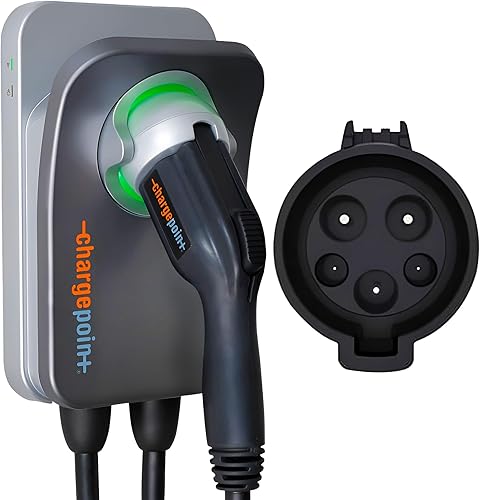
ChargePoint Home Flex
The manufacturer's Home Flex listing puts the output range at 16A to 50A, chosen during setup and changeable later, which is exactly the lever a tripping circuit needs. If an electrician finds the garage feeder is really a 30A circuit, the same hardware drops to 24A instead of going back in the box. Premium pricing, and the app is where the setting lives.
Check it on Amazon →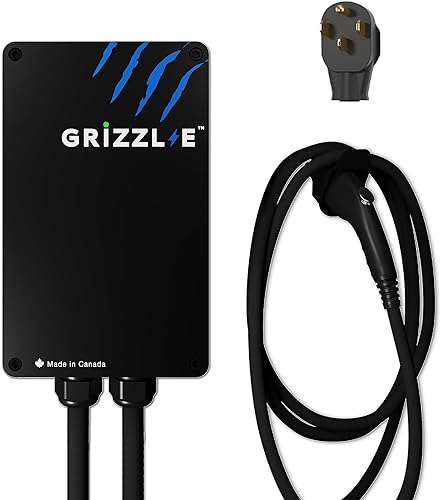
Grizzl-E Classic Connect
A 40A J1772 unit in a metal enclosure, configured to the circuit during installation rather than from a phone each time. The app is optional, and the unit charges with or without a connection, so a dropped network never becomes a second troubleshooting problem on top of the breaker. Also priced in the premium bracket. Confirm the current table on the unit's own label before closing it up.
See it on Amazon →Side by Side on Current Control
Only one column really matters for a breaker that keeps opening: how the charger's current limit gets set, and how low it goes.
| Charger | Max Current | Current Setting | Lowest Setting | Connector | Works Offline | Price | Link |
|---|---|---|---|---|---|---|---|
| ChargePoint Home Flex | 50A (about 11.5 kW) | 16A to 50A in the app | 16A | J1772 | Charges after setup | $$$$ | View |
| Grizzl-E Classic Connect | 40A (about 9.6 kW) | Set at install, app optional | Check the unit's label | J1772 | Yes, with or without WiFi | $$$$ | View |
Price tiers are approximate. $ = under $50, $$ = $50 to 150, $$$ = $150 to 300, $$$$ = over $300. Tap any link for the current Amazon price.
The 80 Percent Rule Is Usually the Whole Story
A circuit breaker is not a switch that flips the instant its number is exceeded. It is a thermal device, and it will carry its full rating for a while before the internal strip bends far enough to open. That tolerance is why a shop vac on a 15A circuit can start without nuisance trips, and it is also why a charging session can run for an hour and then fail without warning.
Home charging is the hardest case for that design, because it is a continuous load. The National Electrical Code (NFPA 70) treats a load as continuous when the maximum current is expected to run for three hours or more, and continuous loads get sized at 125 percent of the load, which is the same arithmetic as limiting the load to 80 percent of the breaker. A car pulling steady current for six hours overnight sits at the far end of that, and the breaker warms the whole time.
So the pairings that work are fixed: 16A on a 20A breaker, 24A on a 30A breaker, 32A on a 40A breaker, 40A on a 50A breaker, 48A on a 60A breaker. Our breaker sizing guide for a 48A charger walks through why the top of that list needs a 60A circuit, not the 50A circuit a NEMA 14-50 outlet suggests. The most common version of this failure is a 40A charger installed on a 40A breaker because both numbers matched: it will often charge fine in cool weather and then start tripping in July.
One detail that gets missed: the limit lives in the charger, not the car. Dropping the charge current in a vehicle app does sometimes stop the trips, but the setting is per-vehicle and resets more easily than people expect, and a second car on the same charger will not inherit it. Fix it at the wall instead.
What Dialing Down Actually Costs You
The reason to take this seriously rather than live with it: the speed penalty for matching the circuit is smaller than it sounds. A 40A charger delivers roughly 9.6 kW, and a 32A setting on the same hardware delivers about 7.7 kW. Over an eight-hour overnight window that is the difference between roughly 77 kWh and 62 kWh of theoretical delivery, and almost no household actually needs either number. Daily driving of 40 miles is around 12 kWh.
Set against that, a charger that trips at 2 a.m. gives you zero kWh and a car you cannot drive. The amperage comparison across 16A, 32A, 40A and 48A puts real range-per-hour figures on each step if you want to see where the curve flattens. For anyone charging overnight on a daily commute, the honest answer is that the circuit you already have is probably enough once the charger is set correctly.
When the Trip Is Not an Overload
Timing separates the cases. A breaker that opens within seconds of the handle going into the car is not thermal, because nothing has had time to heat up. That pattern points at a ground fault, and the usual sources are water in an outdoor NEMA 14-50 receptacle, a pinched or abraded cable, a loose neutral, or a GFCI breaker reacting to the small leakage current a charger produces at startup.
Two things worth knowing here. First, a charger with its own internal ground-fault protection sitting behind a GFCI breaker can produce trips that neither device would produce alone; whether the local inspector requires that stacked arrangement is a question for the permit office, and our permit guide for a Level 2 install covers how that conversation usually goes. Second, plug-in installs fail at the plug more often than anywhere else. A NEMA 14-50 receptacle sold for a dryer sees a few hours of use per week; the same receptacle on a charging circuit sees six hours every night, and heat at a slightly loose blade will discolour the face before it ever trips the breaker. Pull the cover and look at the contacts if a plug-in charger starts misbehaving after a year of working fine. That is a good argument for a hardwired install when the wall is already open.
And if the charger setting is already at 80 percent, nothing else shares the circuit, and the contacts look clean, suspect the breaker itself. Thermal-magnetic breakers age, and a breaker that has tripped many times gets easier to trip, not harder.
The Order to Work Through It
Work from cheapest to most expensive, and change one thing at a time:
- Write down how long charging ran before each trip. Seconds, minutes, or hours decides everything that follows.
- Read the breaker rating in the panel, then read the charger's current setting. If the setting is above 80 percent of the breaker, that is the answer.
- List what else is on that circuit. A freezer, a well pump, or a garage heater cycling on top of a charger near the limit will trip a breaker that holds fine when the charger runs alone.
- On a plug-in install, inspect the receptacle for discolouration or play in the blades, and replace a dryer-grade receptacle with one rated for continuous duty.
- Only then consider the breaker, the wire gauge, or a different charger. Those are electrician jobs, and the installation guide sets out what to ask for.
If step 2 is where you land and the charger cannot be set lower than its rating, the hardware is the limiting factor and a settable unit is the cheaper fix compared with rebuilding the circuit for more current.
What Owners Report After the Swap
Verified-buyer reviews for both of these chargers converge on the same point from opposite directions. Home Flex buyers repeatedly describe choosing a lower output during setup to suit an older panel and then forgetting about it, with the app's adjustable limit treated as the reason the unit fit the house at all. The recurring complaint is the opposite: setup depends on the phone and the network, and buyers who hit WiFi problems in a detached garage describe a frustrating first evening.
Grizzl-E buyers describe the trade in reverse. The metal enclosure and the lack of any network dependency come up again and again as the appeal, usually from people who had already replaced a charger that failed outdoors, and the unit's willingness to charge without a connection is what they point to. The criticism is that configuration happens in hardware, so it is not something you adjust from the couch.
For a circuit that keeps tripping, both answers are valid. The question is whether you would rather be able to change the setting later, or never depend on a network to charge.
Which to Buy
Buy the ChargePoint Home Flex if the circuit's true capacity is uncertain, or if it may change: a panel upgrade in a year, a second car, a solar install, or an electrician who has not yet traced the feeder. The 16A to 50A span means the wrong guess costs a setting change rather than a return. It is also the better choice if the car stays on a schedule, since the same app that holds the current limit holds the timer.
Buy the Grizzl-E Classic Connect if an electrician has already confirmed the circuit, the charger lives outdoors or in an unheated garage, and you would rather the charging work never route through a router. Set it to the circuit once and the only thing left to do is plug in. If you want to see how either sits against the wider field before deciding, the full Level 2 charger comparison ranks them against the rest of the market on speed, enclosure and smart features.
What neither charger fixes is a trip that happens in the first seconds of a session. That is a wiring or ground-fault question, and no amount of current setting will make it safe to keep resetting the breaker.
FAQ
Where These Numbers Come From
Both chargers here were chosen for one property: the current limit can be matched to the circuit that exists, rather than dictating the circuit you have to build. Current ranges, connector types and enclosure ratings come from the manufacturers' own product documentation; the continuous-load and 125 percent sizing rules come from NFPA 70. Owner sections paraphrase recurring themes across verified-buyer reviews in our own words rather than quoting any reviewer. Price tiers reflect the bracket each listing sat in at the last scheduled audit, and both units are premium-bracket hardware. Nothing on this page is a substitute for a licensed electrician reading your panel. Our methodology page sets out the star floor and the audit cycle in full.
Prices and availability reflect Amazon listings at time of writing. Confirm on the product page before purchase.