Quick answer: this matchup reduces to panel headroom versus price. Most buyers should take the Emporia Pro Level 2 and pocket the difference. The ChargePoint Home Flex is the right call when your electrical panel is tight, because it dials output anywhere from 16A to 50A.
Head-to-Head Verdict
Emporia Pro Level 2
The Emporia gives you 48A charging, WiFi, app control, and voice assistant support. On raw specs, it matches the ChargePoint and adds PowerSmart load management plus an Ethernet port, and that same 48A ceiling is what separates it from the 40A Autel in our Autel MaxiCharger vs Emporia Pro matchup. If a crowded panel or a wired network connection matters more than app polish, this is the one to buy.
See it on Amazon →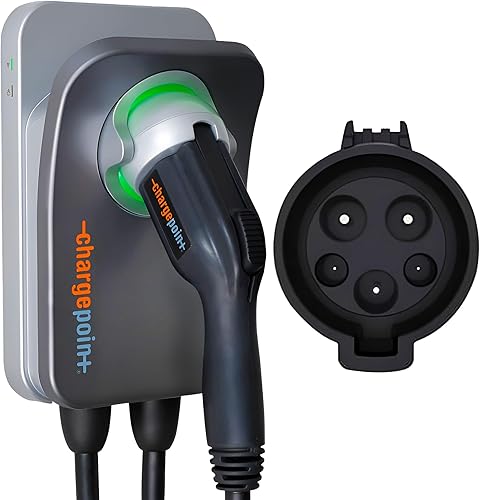
ChargePoint Home Flex
Adjustable amperage from 16A to 50A lets this charger fit almost any electrical panel. The app is the best in the business. You do pay a premium, but the hardware earns it.
Check it on Amazon →Head-to-Head Comparison
Every spec that matters, side by side. Green cells show the winner in each row.
| Spec | ChargePoint Home Flex | Emporia Pro |
|---|---|---|
| Max Amperage | 50A | 48A |
| Charging Speed | 37 mi/hr | 36 mi/hr |
| Amperage Range | Adjustable 16A-50A | Fixed 48A |
| Cord Length | 23 ft | 25 ft |
| WiFi | Yes | Yes |
| App Control | Yes (superior app) | Yes |
| Alexa / Google | Yes / Yes | Yes / Yes |
| Energy Monitoring | Detailed per-session | Basic real-time |
| Plug-in Option | NEMA 14-50 | NEMA 14-50 |
| Hardwire Option | Yes | Yes |
| Connector | J1772 | J1772 |
| Price | $$$$ | $$$$ |
| Buy | Check it on Amazon → | See it on Amazon → |
Price tiers are approximate. $ = under $50, $$ = $50 to 150, $$$ = $150 to 300, $$$$ = over $300. Tap any link for the current Amazon price.
Owners Split: ChargePoint vs Emporia
Spec tables tell part of the story. Here is what shows up in verified-purchase reviews for both chargers.
ChargePoint Home Flex (4.3-star verified-buyer average)
Five-star owners describe stylish, fast hardware with an app that pairs within minutes of a professional mount, and a car-industry reviewer rates the build as quality gear that a handy owner can put on an existing 14-50 outlet themselves. The one-star side is dominated by firmware and connectivity pain, and it isn't isolated. If you rely on the app, budget patience for setup.
Emporia Pro Level 2 (4.8-star verified-buyer average)
Recent verified buyers describe install-to-charging timelines of roughly an hour on a pre-existing dryer plug, and one found the in-app assistant quick and accurate on a load question. Daily drivers report rock-solid, set-and-forget service at 40A continuous. The shared warning is a thick, inflexible power cord, so plan your plug clearance before mounting. Complaints are also noticeably rarer here than on the ChargePoint's page.
Jacob’s read on this category
This matchup reduces to one question: what does the ChargePoint premium buy? The honest list is adjustable amperage, a deeper app, and nicer build, and none of it adds charging speed, so at the national-average 16 cents per kWh the price gap equals several hundred kWh of electricity you are trading away. My split is electrical, not emotional: a panel near capacity favors the ChargePoint, because dial-down amperage is a genuine wiring feature, not an app toy. Everyone else gets the identical overnight outcome from the Emporia and keeps the difference.
How This Head-to-Head Was Researched
This head-to-head started from a simple question: is the price difference justified? I pulled both chargers' current specs from the manufacturer product pages, re-checked Amazon prices against the current listings on October 17, 2026, then mined the top-helpful verified reviews for each unit to see where owner experience lines up with the spec sheet and where it diverges. No manufacturer paid for placement and I don't take review units. If something falls short in owner reports, it shows up in the verdict above.
Charging Speed
Winner: ChargePoint Home Flex, barely.
The ChargePoint Home Flex tops out at 50 amps, which works out to roughly 37 miles of range per hour on a 240V circuit. The Emporia Pro runs at 48 amps, good for about 36 miles per hour. The gap is one mile per hour. Over an eight-hour overnight charge, the ChargePoint adds about 296 miles while the Emporia adds 288. That's eight extra miles by morning.
Honestly, that gap is meaningless in daily use. Unless you drain a 100+ kWh battery to near empty every night and need every last mile back by morning, you'll never notice. Both chargers can top up any mainstream EV overnight with hours to spare.
The ChargePoint's real speed advantage isn't the 2-amp bump. It's the adjustable 16A to 50A range. You can dial it down to 16 amps for a smaller panel, or push it to 50 if your capacity allows. The Emporia is locked at 48 amps. If your panel can't accommodate a 60-amp breaker (required for 48A under the NEC 125% rule), the Emporia won't fit without an expensive panel upgrade. The ChargePoint simply steps down to whatever breaker you already have.
For big-battery trucks like the Ford F-150 Lightning or Rivian R1T, both chargers handle overnight charging just fine. Neither one bottlenecks a truck.
Smart Features and App Quality
Winner: ChargePoint Home Flex.
Both chargers have WiFi, smartphone apps, scheduled charging, and Alexa and Google Home support. On paper they look identical. In practice, the ChargePoint app is noticeably better.
ChargePoint gives you detailed per-session energy tracking with cost breakdowns. You can see exactly how many kilowatt-hours each session pulled, what it cost at your electricity rate, and how it stacks up against past sessions. Charging history stretches back months and exports cleanly. If you like to track cost-per-mile or double-check your utility bill against what you actually used, ChargePoint has the data to back it up.
The Emporia app is functional but plainer. You get real-time monitoring, scheduling, and basic energy stats. The interface is less polished and the historical data less granular. Emporia's strength lies in its broader energy monitoring lineup. If you already own an Emporia Vue whole-home monitor, the charger drops into that same dashboard, which is a nice bonus. As a standalone charger app, though, it lags behind ChargePoint.
Scheduled charging works well on both. You pick the hours when your utility bills off-peak rates, and the charger holds off until that window opens. Depending on your rate structure, this alone can save $20 to $50 a month. That's what makes the Emporia's price so hard to beat. Off-peak savings can pay the charger off in under six months.
One caveat: both chargers lean on cloud connectivity for app features. If the manufacturer's servers go down, you lose remote control, though both will keep charging on their last schedule. This isn't a quirk of these two products. It's how every WiFi-connected charger on the market works.
Build Quality and Design
Winner: ChargePoint Home Flex.
The ChargePoint feels like a premium product. The housing is solid. The finish is clean, and the cable management is thoughtful. It has real weight when you mount it, and the charging cable is thick and well-insulated without being clumsy to handle. The holster holds the connector securely. It looks professional on a garage wall, which matters if your charger is visible when the garage door is open.
The Emporia is perfectly adequate but clearly built to a price point. Thinner plastic housing. Fit and finish a step below. Simpler cable management. None of that affects charging performance. The Emporia will charge your car just as reliably as the ChargePoint does. But pick both up and you can feel where the price difference went.
Both units are rated for outdoor use. The ChargePoint Home Flex carries a NEMA 3R rating for rain, sleet, and ice protection, and the Emporia Pro carries a NEMA Type 4 rating, which adds protection against hose-directed water. The ChargePoint handles normal outdoor conditions fine but does best mounted under some kind of overhang; the Emporia, like the Grizzl-E Classic, is specified for fully exposed installs.
Cord length goes to the Emporia at 25 feet versus the ChargePoint's 23 feet. Two feet isn't going to decide anyone's purchase, but if your parking spot sits far from the mounting point, every inch matters. Both are long enough for most single-car garages.
Installation
Winner: Tie, with a ChargePoint advantage for older homes.
Both chargers offer the same two installation paths. You can plug into a NEMA 14-50 outlet or hardwire directly to your electrical panel. If your garage already has a 240V outlet, either charger is running in under five minutes. No electrician required.
For hardwired installs, both need a licensed electrician. The job typically runs $500 to $1,500 depending on panel capacity and how far the cable has to travel from the panel to the mounting point. Neither unit is meaningfully easier or harder to hardwire than the other.
Here's where the ChargePoint has a real advantage: electrical panel compatibility. The Emporia draws 48 amps, which means it needs a 60-amp breaker per NEC code (125% of continuous load). Plenty of older homes have 100-amp or 150-amp panels. Once you account for existing loads like HVAC, water heater, dryer, and range, there may not be room left for a 60-amp breaker.
The ChargePoint sidesteps this entirely. You can dial it down to 32 amps on a 40-amp breaker, 24 amps on a 30-amp breaker, or even 16 amps on a 20-amp breaker. That kind of flexibility lets you drop the ChargePoint into almost any home without upgrading your panel. A panel upgrade on its own runs $2,000 to $4,000.
If you already have a 200-amp panel with plenty of headroom (common in homes built after 2000), the advantage disappears. Both chargers install the same way. But in an older home with a tighter panel, the ChargePoint's adjustable amperage isn't just a convenience. It could save you thousands.
Price: Is the Premium Worth It?
Winner: Emporia Pro, narrowly.
The ChargePoint Home Flex and the Emporia Pro Level 2 now sit in the same $$$$ tier. So what does each one give you for roughly the same money? (If Wallbox is also on your list, the three-way ChargePoint vs Wallbox vs Emporia comparison and the Wallbox vs Emporia head-to-head cover that angle.)
Three things: adjustable amperage, a better app with more detailed energy tracking, and higher build quality. That's the full list. You don't get meaningfully faster charging. You don't get more smart features. You don't get better voice assistant integration, a longer cord, or broader vehicle compatibility.
Put that gap in EV-charging terms. At the national average rate of $0.16/kWh, the price difference buys you several hundred kilowatt-hours of electricity, enough to drive a couple thousand miles. It works out to roughly two months of charging, depending on how much you drive.
Dollar for dollar, the Emporia Pro is one of the best deals in the entire EV charger market. It competes on features with pricier products and beats most of them. The only reason to spend more is a specific need, and the ChargePoint's adjustable amperage is the most legitimate specific need on the table.
If you're buying your first EV charger and your panel can handle 48 amps, buy the Emporia. Take the money you saved and put it toward your electricity bill or a home energy monitor. The Emporia will charge your car just as well as the ChargePoint, every single night, for years.
Which Should You Buy?
Check Emporia Pro price on Amazon → Check ChargePoint Home Flex price →