Quick answer: all three are legitimate smart chargers, so rank them by your priority: the ChargePoint Home Flex owns the app experience, the Wallbox Pulsar Plus is the one to pair with solar, and the Emporia Pro Level 2 matches the core specs and bundles load management, the one feature the other two sell as add-ons.
How the Three-Way Shakes Out
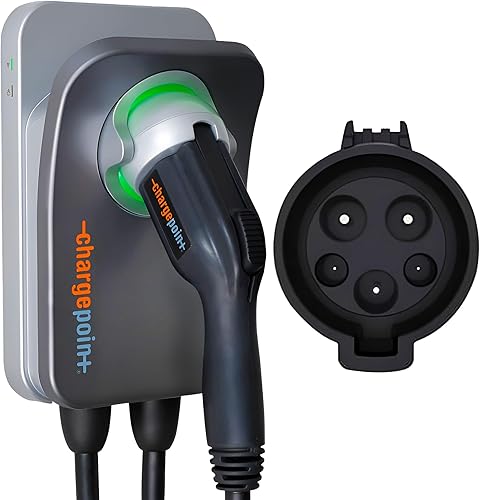
ChargePoint Home Flex
Deepest app in the category. Per-session cost in dollars, CSV export, Alexa and Google Home native. Adjustable 16-50A. Premium feature set.
Check it on Amazon →
Wallbox Pulsar Plus
Eco-Smart dynamic solar matching via the Power Meter accessory. Premium build quality. The choice if you have solar.
Check it on Amazon →Emporia Pro Level 2
48A, smart, WiFi and Ethernet, with dynamic load management in the box. Native integration with Emporia Vue for energy monitoring.
See it on Amazon →Three-Way Spec Table
All three are smart, WiFi-connected Level 2 chargers in the same price tier. The differences are in app depth, solar integration, and long-term reliability.
| Charger | Amps | Connector | Smart Features | Price | Rating | Link |
|---|---|---|---|---|---|---|
| ChargePoint Home Flex | 50A adjustable | J1772 | WiFi, Alexa, Google, CSV | $$$$ | 4.3 | View |
| Wallbox Pulsar Plus | 48A | J1772 | WiFi, Eco-Smart, OCPP | $$$$ | 4.1 | View |
| Emporia Pro Level 2 | 48A | J1772 | WiFi, native Vue integration | $$$$ | 4.8 | View |
Price tiers are approximate. $ = under $50, $$ = $50 to 150, $$$ = $150 to 300, $$$$ = over $300. Tap any link for the current Amazon price.
Three Fan Bases, Compared Honestly
Pulled from verified-purchase Amazon reviews as of 2026-05-27.
ChargePoint Home Flex (4.3-star verified-buyer average)
ChargePoint owners praise the app depth: per-session cost in dollars, CSV export for tax tracking, voice integration. The 4.3-star rating reflects WiFi reconnect complaints largely resolved by recent firmware. For smart-home obsessives who want the deepest app, this is the pick.
Wallbox Pulsar Plus (4.3-star verified-buyer average)
Solar-home owners universally cite the Eco-Smart dynamic surplus matching as the killer feature. The Power Meter accessory (sold separately) is required for the solar integration to work. Without solar, the Wallbox gives up its main reason to cost more than the Emporia. With solar, no competitor matches the integration.
Emporia Pro Level 2 (4.8-star verified-buyer average)
Emporia's 4.8-star verified-buyer average is the reliability winner. Owners report minimal WiFi issues, intuitive scheduling, and the deepest energy-tracking integration if you already own the Emporia Vue 2 whole-home monitor. The value pick by a clear margin.
Jacob’s read on this category
Three-way comparisons get decided on launch-week features; this one should be decided on month-twelve behavior. The verified-review record splits cleanly: Emporia runs quietest, ChargePoint’s complaints cluster on WiFi reconnects that newer firmware has mostly settled, and Wallbox simply has a shorter track record to judge yet. Remember that feature depth ages worse than hardware, because an app overhaul or a sold-off cloud service reshuffles software rankings overnight while the enclosure keeps doing its job. Weight the reliability section above over the app screenshots; it is the part of this page most likely to still be true in three years.
App Depth, Side by Side
ChargePoint: per-session cost in dollars based on your utility rate, CSV export for tax tracking, Alexa and Google Home native, adjustable amperage from the app. Deepest set of features. Worst connectivity history of the three (occasional WiFi disconnects).
Wallbox: Eco-Smart mode for solar surplus matching, OCPP support for multi-charger management, MyWallbox cloud for remote monitoring. Cleaner UI than ChargePoint but fewer features.
Emporia: simpler app, focused on scheduling and energy tracking. Native integration with the Emporia Vue whole-home energy monitor for solar-aware charging. Most reliable WiFi of the three.
Solar Integration Trade
Wallbox wins outright if you have solar and want dynamic surplus matching. The Power Meter accessory (sold separately) reads net export and feeds the charger so it draws exactly your surplus.
Emporia wins if you already own the Emporia Vue energy monitor: the integration is native, no extra hardware needed.
ChargePoint has no built-in solar integration. You can fake it with scheduling (charge only during daylight hours) but there's no dynamic match.
Long-Term Reliability (12+ Months)
Across verified Amazon reviews and EV-charging subreddits, the three rank like this on 12-month reliability:
Emporia: 4.8-star average across consistently strong verified-buyer sentiment. Owners report minimal connectivity issues and consistent firmware updates. The reliability winner.
Wallbox: 4.3-star verified-buyer average (newer to market). Reports are mostly positive but skew earlier-adopter.
ChargePoint: 4.3-star verified-buyer average. The reliability complaints cluster around WiFi reconnect issues that the recent firmware update has largely fixed, though some users on older firmware still report intermittent drops.
Price Reality
Wallbox Pulsar Plus: list price plus the Power Meter accessory for the solar use case, the most expensive setup here.
ChargePoint Home Flex: mid-priced, no required accessories.
Emporia Pro Level 2: the load-management pick, no required accessories (the PowerSmart Vue 3 monitor ships in the box).
If you're not specifically optimizing for solar, the Emporia is the pick, because it delivers the same 48A with load management bundled and no add-on to buy. If solar is the priority, Wallbox + Power Meter is worth the premium.
The 5-Year Cost of Ownership, Run Honestly
All three sit in the same $$$$ tier, so over five years the real spread comes from the circuit you install, the accessories your use case needs, and the electricity itself.
Electricity dwarfs the hardware gap. A 12,000-mile year at 3.5 miles per kWh is about 3,430 kWh; at the $0.17 per kWh national average, roughly $580 a year and $2,900 over five years, several times the gap between any two of these units. On a time-of-use plan with a 30-cent peak and 12-cent overnight rate, off-peak scheduling shifts about $610 a year, and all three schedule. Run your own rate through our charging cost calculator.
The install decides the budget. The 48A spec on the Wallbox and Emporia (compared one-on-one in Wallbox vs Emporia), and the full 50A on the ChargePoint, only exist hardwired. NEC 625.41 sizes the breaker at 125 percent of this continuous load: 48A needs a 60A breaker, while 50A computes to 62.5A and rounds up to a 70A breaker under NEC 240.6, usually forcing a step from 6 AWG to 4 AWG copper at roughly $2 to $3 more per foot. On a NEMA 14-50 plug with its 50A breaker, all three are capped at 40A. Budget near $0 if a suitable 14-50 sits within cord reach, $300 to $800 for a new 14-50 run, $500 to $1,300 for a hardwired 60A circuit, and $2,000 to $4,500 if a NEC 220.83 load calculation shows the panel cannot spare 60A. Our installation guide walks through the load math.
Is hardwiring worth it? 40A at 240V is 9.6 kW; 48A is 11.5 kW. At 3.3 miles per kWh that is 32 versus 38 miles of range per hour, and 8 overnight hours on plain 40A deliver 77 kWh, more than most EV packs hold. Pay for the bigger circuit only if you regularly arrive near empty on a short turnaround or two EVs share one charger.
Subscription risk. As of our June 2026 fact-check, none of the three charges a subscription for home app features. The risk is structural: ChargePoint and Wallbox run paid commercial charging clouds the home apps share infrastructure with, funded servers today but an obvious place to move premium features later. Emporia's app has stayed free across its Vue line since launch, the steadiest record here, though nothing guarantees the policy.
If the Company Folds: Offline Behavior by Brand
These are 10-year hardware purchases tied to apps with no 10-year guarantee. Here is what each manufacturer's documentation says the unit does once the cloud is gone.
ChargePoint Home Flex. ChargePoint's documentation states the unit keeps charging without internet: plug a car in and it starts at the last configured amperage. The catch is configuration. The 16 to 50A output is set through the app at commissioning, with no DIP switches on the unit, so an app sunset freezes the charger at its last setting. Fine on the circuit it was commissioned for, but you could never derate it for a smaller circuit later, and NEC 625.42 requires the output setting to match the breaker.
Wallbox Pulsar Plus. The best documented survivability here. The myWallbox app connects locally over Bluetooth, so daily control does not depend on Wallbox's servers, and the firmware documents OCPP 1.6J support, so the unit can be re-pointed at a third-party backend if the cloud ever shuts down. Per Wallbox's OCPP guide, switching disables the myWallbox feature set, including the Eco-Smart solar matching that justifies the unit in the first place.
Emporia Pro Level 2. Per Emporia's documentation, the charger behaves as a standard J1772 EVSE without WiFi, starting at the configured rate whenever a car plugs in. Like ChargePoint, amperage is app-set with no hardware fallback and no OCPP path, so settings freeze if the app goes away. A frozen Emporia is still a working 48A charger, which is most of what you paid for.
The buyer each one loses
ChargePoint loses the value buyer: the highest non-solar setup cost here, app-only configuration, and the weakest WiFi track record. If you will never open the CSV export or talk to Alexa, you are buying the deepest app to use its shallowest features.
Wallbox loses the no-solar buyer: without panels, Eco-Smart is dead weight and the Power Meter (a $$$-tier add-on plus CT install labor) never enters the budget, yet you pay the solar-flagship price against an Emporia that matches it amp for amp.
Emporia loses the data buyer: no voice control, no per-session cost export for mileage reimbursement, no OCPP. Anyone needing charging records for a work vehicle outgrows this app first.
FAQ
The Research Behind This Three-Way
Every cell in the table above traces to the named manufacturer's spec sheet, and where documentation was ambiguous we deferred to the current install manual instead of guessing. Amazon price tiers and availability for all three chargers were re-verified on October 17, 2026. We would put any of the three in our own garage, and none of the brands had a say in the ranking. Read the full research methodology.