Quick answer: match the plug to the car before anything else. With a Tesla in the driveway, the Tesla Wall Connector delivers native NACS at the full 48A. For J1772 EVs, the Emporia Pro Level 2 is the true 48A hardwire with bundled load management for a tight panel, while the ChargePoint Home Flex, in the same price tier, adds adjustable output and the strongest app.
Three Verdicts
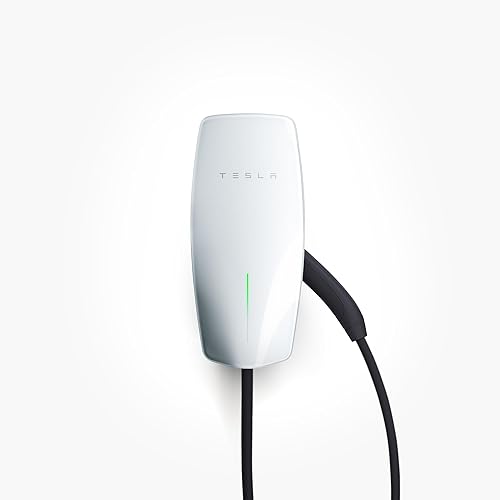
Tesla Wall Connector
Native NACS at 48A. Integrated pre-conditioning. WiFi for OTA updates. The only home charger that does NACS without an adapter.
View on Amazon →Emporia Pro Level 2
48A at the lowest price in the category. WiFi scheduling, per-session energy tracking, 25 ft cord. The value benchmark.
See it on Amazon →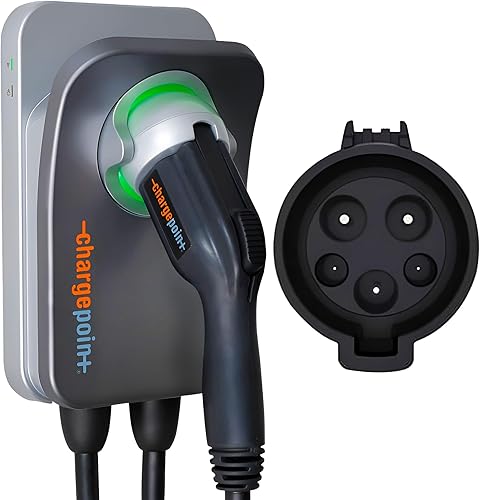
ChargePoint Home Flex
Adjustable 16-50A, deepest app in the category, per-session cost tracking. Alexa and Google Home native integration.
Check it on Amazon →48A Spec-Sheet Showdown
All three deliver 48A continuous on a 60A breaker (hardwired). Speed is identical; differentiation is connector type and app depth.
| Charger | Amps | Connector | Smart | Price | Rating | Link |
|---|---|---|---|---|---|---|
| Tesla Wall Connector | 48A | NACS | WiFi, Tesla app | $$$$ | 4.8 | View |
| Emporia Pro Level 2 | 48A | J1772 | WiFi, app | $$$$ | 4.8 | View |
| ChargePoint Home Flex | 50A adjustable | J1772 | WiFi, Alexa, Google | $$$$ | 4.3 | View |
Price tiers are approximate. $ = under $50, $$ = $50 to 150, $$$ = $150 to 300, $$$$ = over $300. Tap any link for the current Amazon price.
How These 48A Units Hold Up for Owners
Pulled from verified-purchase Amazon reviews as of 2026-05-27.
Tesla Wall Connector (4.8-star verified-buyer average)
Tesla owners universally praise how tightly the charger integrates with the car. Charging starts automatically when plugged in, and the Tesla app shows session data in the car's own UI. The cord is on the stiff side in cold weather (same as competitors) but the auto-start logic minimizes time spent wrestling the cord.
Emporia Pro Level 2 (4.8-star verified-buyer average)
The Emporia is the J1772 pick for a panel that is already close to full, since PowerSmart load management ships in the box rather than as an add-on. Owners report reliability on par with the ChargePoint and Tesla units, and the per-session energy tracking is unusually detailed. The 25 ft cord wins over the 23-foot ChargePoint for tricky garage layouts.
ChargePoint Home Flex (4.3-star verified-buyer average)
ChargePoint is the smart-home obsessive's pick. The app shows per-kWh cost based on your utility rate, exports session data to CSV for tax tracking, and the amperage adjustability is genuinely useful for shared garages. The 4.3-star rating reflects occasional connectivity issues that the firmware updates have largely resolved.
Jacob’s read on this category
At 48A the install quietly becomes a bigger line item than the hardware. NEC 625 requires a 60A breaker and a hardwired connection, so plan on $600 to $1,400 of electrician work, plus $1,500 to $3,000 more if the panel needs an upgrade before it can take the breaker. My rule from my own hardwired 60A install: get the load calculation done before you buy anything, because a panel that fails it turns a 48A charger into an expensive 40A charger. If the math clears, the Wall Connector and Emporia both hold 48A continuous without complaint, and the 20% bump over 40A is real, but only a big-battery EV driven hard makes it worth the wiring.
Why 48A Is the Practical Ceiling
For non-truck EVs, 48A continuous is the maximum that the onboard charger in the car can accept. Tesla Model Y, Model 3, Model S, Rivian R1S (and the R1T), Lucid Air, BMW i4, Polestar 2, and most Korean EVs (Ioniq 5/6, EV6, GV60) all max out at 11.5 kW (48A) Level 2.
Going above 48A on the charger side does not increase charging speed for these cars. The exceptions are F-150 Lightning (80A capable), Hummer EV (80A), and a handful of luxury sedans (Lucid Air Sapphire, certain Mercedes EQS trims).
48A delivers about 36 miles of range per hour to a typical EV. Over an 8-hour overnight charge that is 288 miles added, enough for nearly any non-road-trip use case.
Hardwire Required
Every 48A charger should be hardwired, not plugged into a NEMA 14-50 receptacle. NEC 625 requires the receptacle to be rated for at least 125% of the continuous load. For 48A continuous, that is 60A, and NEMA 14-50 receptacles are 50A maximum.
Many owners run 40A on a 14-50 (which IS within spec) and then upgrade later to 48A hardwire. If you know you want 48A from day one, run the 60A circuit and hardwire from the start. The labor cost is identical.
The 125% figure comes from NEC 625.41 and 210.20(A): 48A continuous times 1.25 is exactly 60A, so the breaker is a two-pole 60. The conductor is where quotes go wrong. Copper 6 AWG THHN/THWN-2 in conduit is rated 65A at the 75°C column and passes. Standard 6/2 NM-B (Romex) does not: NEC 334.80 holds NM cable to the 60°C column, where 6 AWG copper is good for only 55A, so Romex runs need 4 AWG. If a 60A-circuit quote lists 6/2 Romex, raise it before the inspector does.
Hardwiring also dodges a plug-in-only cost: NEC 625.54 requires GFCI protection on any receptacle serving an EV charger, a two-pole GFCI breaker at roughly $100 to $160 versus $15 to $30 standard, and stacking breaker GFCI on the charger's built-in CCID electronics is a known nuisance-trip combination that charger install manuals warn about. A hardwired unit lands on a standard breaker. If you would rather stay plug-in at 40A, our NEMA 14-50 charger picks cover that route.
Will Your Panel Pass the 60A Load Calc?
A 60A circuit is the largest single load most houses will ever add, and most jurisdictions require a service load calculation before issuing the permit. The standard tool is NEC 220.83, the optional method for adding load to an existing dwelling: count the first 8 kVA of existing load at 100%, the remainder at 40%, air conditioning at 100%, then add the charger at its full 11.5 kVA nameplate.
Worked example for a typical 2,000 sq ft all-electric home:
- General lighting at 3 VA per sq ft (NEC 220.12): 6,000 VA
- Two small-appliance circuits plus laundry (NEC 220.52): 4,500 VA
- Range 8,000 VA, dryer 5,000 VA, water heater 4,500 VA, dishwasher 1,200 VA
- Central A/C: 3,500 VA
Everything except the A/C totals 29,200 VA. Apply 220.83: the first 8,000 at 100%, plus 40% of the remaining 21,200 (8,480), plus the A/C at 100%, gives 19,980 VA of existing demand. Add the charger's 11,500 VA and divide by 240 V: 131A calculated load.
On a 200A service that passes with nearly 70A of headroom. On a 100A service the same house fails by 31A, and the part that surprises people is that turning the charger down barely helps: re-run the math at 24A (5.76 kVA) and the calc still lands at 107A. A 100A-panel home realistically has three options: a service upgrade ($1,500 to $3,000, more if the utility drop needs work), an automatic load-management controller that interrupts the charger when whole-house draw nears the service limit (roughly $400 to $900 installed), or a charger with dynamic load management, which Emporia's documentation supports when its unit is paired with the company's panel-mounted energy monitor.
The interesting middle case is a 125A service: the example house clears the calc at 40A (123A) but fails at 48A (131A). That borderline band is where the ChargePoint Home Flex's adjustable amperage earns its keep. Run 6 AWG copper sized for 60A from day one, land it on a 50A breaker, commission the Flex at 40A, and a future panel upgrade becomes a breaker swap plus an app setting instead of a rewire.
The failure mode to avoid is buying the charger first. The order is load calc, then circuit, then hardware; run it backwards and the symptom is a 48A unit permanently software-limited to half its rating. Our installation guide covers permits, panel sizing, and what the electrician's quote should itemize.
48A vs 40A Real-World
Daily commuter, 50 miles round trip: identical experience. Both chargers refill the daily delta in under 2 hours.
Weekend warrior, 200 miles in a single day before bed: 48A finishes in 6.5 hours, 40A in 7.5 hours. Both done by morning.
Long-trip arrival home with 5% battery before 7am departure: 48A finishes 95% in 7.5 hours, 40A in 8.5 hours. Only here does 48A win meaningfully.
The arithmetic behind those numbers: 48A at 240V is 11.5 kW, 40A is 9.6 kW, a gap of 1.9 kW. At the roughly 3.1 mi/kWh a Model Y or Ioniq 5 returns in mixed driving, that gap is about 6 miles of range per hour; an efficient sedan like the Model 3 or Polestar 2 at closer to 4 mi/kWh gains 7 to 8. Unlike DC fast charging, Level 2 AC holds its full rate until the last few percent, so the flat math applies across the whole session.
Pack size decides whether the gap matters, using the cars named above:
- Model Y Long Range, ~75 kWh pack: an 80% refill is 60 kWh, so 5.2 hours at 48A versus 6.3 at 40A. Both fit any overnight window.
- Ioniq 5 / EV6, 77.4 kWh pack: nearly identical, 5.4 versus 6.5 hours for the same refill. The hour saved is real but invisible if you sleep through it.
- BMW i4, ~81 kWh pack: a near-full 70 kWh session runs 6.1 hours at 48A, 7.3 at 40A. Still comfortably overnight either way.
- Rivian R1S, ~135 kWh Large pack: where 48A stops being a luxury. In an 8-hour window, 48A puts back about 92 kWh (68% of the pack) versus 77 kWh (57%) at 40A. At the R1S's real-world 2.3 mi/kWh, that 15 kWh gap is about 35 miles of range, forfeited every night you need a deep refill before an early departure.
The decision rule that falls out: pack under 90 kWh with a normal overnight window, a 40A unit on a cheaper 50A circuit covers you (and if the unit price is the constraint, the cheapest 48A chargers roundup ranks the sub-$300 options). Pack over 100 kWh, or a charging window regularly under 7 hours, and the 60A circuit pays for itself the first time you come home empty.
FAQ
Behind the 48A Rankings
Ranking 48A chargers is mostly an exercise in reading fine print: a 48A badge only counts if the unit is hardwired on a 60A circuit, so we verified that detail in each manufacturer's install manual before anything made this page. Listings, stock, and price tiers were re-verified on Amazon on October 17, 2026. There are no sponsorships or free review units behind these picks. Read the full research methodology.