Quick answer: every Ioniq 5 trim tops out at 10.9 kW on AC (the same E-GMP limit as the Kia EV6), so buy for install fit rather than extra amps; our full Level 2 roundup covers the wider field. Hardwired at 48A, the Emporia Pro Level 2 reaches that ceiling and bundles load management for a panel that is already busy. The Tesla Universal Wall Connector is the native-NACS route for 2025+ cars, and the Wallbox Pulsar Plus is the one to mount somewhere fully exposed to weather.
Where Each Charger Lands for the Ioniq 5
Emporia Pro Level 2
Hardwired at 48A it hits the Ioniq 5's full speed. WiFi scheduling, energy tracking, and a 24-foot cord come standard. The lowest price in this guide for a true 48A unit.
See it on Amazon →Tesla Universal Wall Connector
One handle, two cars. The NACS plug works straight into a 2025+ Ioniq 5, and the integrated J1772 adapter pivots out for a 2022 to 2024 model or any other J1772 EV.
Check price on Amazon →
Wallbox Pulsar Plus
48A (adjustable 16-48A) with a 25-foot J1772 cable, WiFi + Bluetooth, and a NEMA Type 4 weather-sealed enclosure. Hardwire only at 48A so plan electrician labor. Assembled in USA.
Check it on Amazon →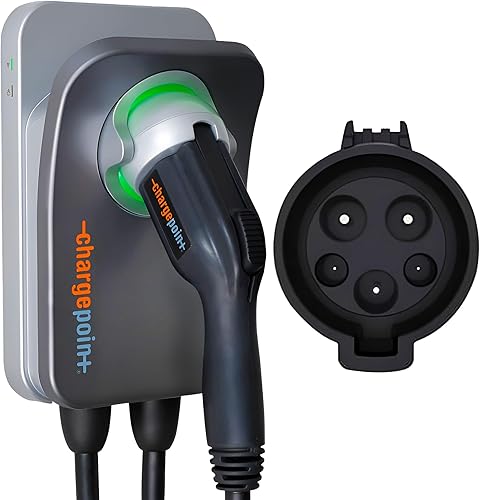
ChargePoint Home Flex
Dial the amps from 16A to 50A in the app, then track every session by cost and energy. The best app in the category, plus tight Alexa and Google Home support.
Check it on Amazon →J1772 vs NACS: Which Plug Do You Need?
Hyundai changed the inlet on the Ioniq 5 between model years. This catches a lot of first-time buyers off guard, so check your year before you buy any charger.
2022, 2023, 2024 Ioniq 5: CCS1 port. Any J1772 charger plugs in directly. No adapter needed. The Emporia, Wallbox, and ChargePoint in this guide all ship with J1772 by default and work without any extra hardware.
2025 and newer Ioniq 5: Native NACS port (same shape as a Tesla). Hyundai includes a J1772 adapter in the trunk, which fits any J1772 charger you already own. So a J1772 home charger still works, you just clip the adapter on first.
If you only own a 2025+ Ioniq 5 and don't want to fiddle with an adapter every night, the Tesla Universal Wall Connector is the cleanest option. It's the only mainstream home charger with a native NACS handle plus a built-in J1772 adapter, so it covers both worlds. The non-Universal Tesla Gen 3 won't work for pre-2025 cars without buying a separate adapter, so make sure you grab the Universal model specifically.
Mixed household? If you have a 2024 Ioniq 5 and a 2025+ Ioniq 5 (or any combination of J1772 and NACS cars), the Universal Wall Connector is the easiest single-charger answer. Otherwise, just pick the J1772 unit you like best and keep using the bundled adapter.
Ioniq 5 Shortlist: The Numbers
Speed figures show miles of Ioniq 5 range added per hour at 240V. The car caps at 48A regardless of charger output, so a 50A unit and a 48A unit deliver effectively the same real-world speed.
| Charger | Amps | Ioniq 5 Speed | Connector | Cord | Price | Link |
|---|---|---|---|---|---|---|
| Emporia Pro Level 2 | 48A | 30 mi/hr | J1772 | 24 ft | $$$$ | View |
| ChargePoint Home Flex | 50A | 30 mi/hr | J1772 | 23 ft | $$$$ | View |
| Tesla Universal Wall Connector | 48A | 30 mi/hr | NACS + J1772 adapter | 24 ft | $$$$ | View |
| Wallbox Pulsar Plus | 48A | 30 mi/hr | J1772 | 25 ft | $$$$ | View |
Price tiers are approximate. $ = under $50, $$ = $50 to 150, $$$ = $150 to 300, $$$$ = over $300. Tap any link for the current Amazon price.
Ioniq 5 Drivers on These Chargers
Spec sheets only get you so far. Here's what shows up repeatedly in verified-purchase Amazon reviews and Ioniq 5 owner forums for the products in this comparison.
Emporia Pro Level 2
A verified Ioniq 5 owner highlights the simple wiring and that the unit charged the car overnight without issue on the very first session. Another reviewer flags cord stiffness in cold weather as the only minor gripe, recommending you mount the holster within easy reach so you're not wrestling the cable in winter. Several owners specifically mention the WiFi setup taking under five minutes.
ChargePoint Home Flex
A verified buyer with a 2023 Ioniq 5 calls out the per-session cost tracking as the feature they actually use most, especially during time-of-use billing windows. A second reviewer praises the build quality and Alexa pairing, while a third notes occasional WiFi disconnects after firmware updates. The app side is the biggest variable in the reviews, both ways.
Tesla Universal Wall Connector
A verified owner with a 2025 Ioniq 5 and a Model Y reports that the single charger covers both cars without swapping adapters or cables. Another reviewer with a 2023 Ioniq 5 says the integrated J1772 adapter clicks on solidly and unlocks reliably each session. A few negative reviews mention wanting a longer cord; 24 feet is fine for a single-bay garage but tight in a deeper one.
Wallbox Pulsar Plus
Ioniq 5 owners point to the 25-foot cord and the NEMA Type 4 weather sealing as the standout features. Multiple reviewers highlight the assembled-in-USA build quality and the granular WiFi+Bluetooth app for off-peak scheduling. The most common gripe: at 48A this is hardwire only, so plan for licensed-electrician labor (no NEMA 14-50 plug shortcut).
Jacob’s read on this category
Every Ioniq 5 takes the same 10.9 kW at home, so the fork in the road is the connector, not the amperage. Keeping the car through the J1772-to-NACS transition argues for the Tesla Universal Wall Connector and its pivot-out adapter that serves both port generations; a lease argues for a plain J1772 unit, since the adapter in the trunk already bridges a 2025+ car to older hardware. I would also resist the 48A reflex here: a 40A unit holds about 85% of full speed, and on a 40 to 80 mile daily top-up that difference never survives until morning. Save the headroom argument for road-trip weeks when the 77.4 kWh pack gets drained hard.
Ioniq 5 Charging Basics
Hyundai gave every Ioniq 5 the same onboard AC charger: 10.9 kW, which accepts up to 48A on a 240V circuit. That number doesn't change between trims, drive types, or model years. So a base SE Standard Range charges at the same AC speed as a top-trim Limited AWD. The battery just takes longer because it's bigger.
At 48A, you add about 30 miles of range per hour. A full 10% to 100% top-up on the long-range 77.4 kWh pack runs roughly 6.5 to 7 hours. That fits comfortably inside an overnight window. The standard-range 58 kWh pack (early SE Standard) tops up faster, around 5 hours from 10 to 100%.
If you bump down to a 40A charger you'll still get about 25 to 26 mi/hr. That's roughly 85% of full speed for less hardware cost. For a daily driver topping off 40 to 80 miles each evening, the difference is invisible. You wake up full either way.
Where 48A actually pays off: long road trips where you arrive late, plug in, and need to leave first thing in the morning. With an 80% to 100% top-up that last hour or two of difference does matter. If that's your usage pattern, lean toward 48A.
Charging Speed: One 10.9 kW Ceiling, Every Trim
All four chargers here (Emporia, Tesla Universal, ChargePoint, Wallbox) deliver effectively identical speed on the Ioniq 5 because the car itself is the bottleneck. The 50A ChargePoint and the 48A units (Emporia, Tesla, Wallbox) all pin at the car's 48A AC ceiling and add about 30 miles of range per hour.
That means you're really shopping on connector type, cord length, app quality, and price. Speed is a tie. Anyone selling you a "faster Level 2 charger" for the Ioniq 5 above 48A is selling you headroom you'll never use on this car. Headroom matters if you plan to add a second EV later that pulls more amps (like an F-150 Lightning at 80A on Ford's Charge Station Pro), but for the Ioniq 5 alone, 48A is the wall.
Smart Features
The ChargePoint Home Flex has the strongest app in this group. Session-by-session cost tracking, Alexa and Google Home, off-peak scheduling, plus the unique amperage dial from 16A to 50A in software. If your panel is tight or you're sharing breakers, that flexibility is worth real money.
The Emporia Pro sits a step below ChargePoint on app polish but covers all the practical features: WiFi scheduling, kWh tracking, and integration with the rest of the Emporia energy ecosystem if you have a Vue monitor or smart panel. For a lower price, the trade is fair.
The Wallbox Pulsar Plus's app does scheduling and energy tracking over both WiFi and Bluetooth. Reviews say it's not as polished as ChargePoint, but it's reliable. If your priority is the NEMA Type 4 weatherproof enclosure or assembled-in-USA build, the Wallbox is the pick at 48A.
The Tesla Universal Wall Connector ties into the Tesla app for power-sharing across multiple connectors, scheduling, and load management. The Tesla app side works mainly with Tesla cars; the Ioniq 5 will charge fine but won't show up as a recognized vehicle in the app, so you control the session from the car or by amperage limit, not by car-aware automation.
Installation
All four chargers need a dedicated 240V circuit. The Emporia and ChargePoint ship with both hardwire and NEMA 14-50 plug options. Emporia is hardwire-only at 48A and drops to 40A on the plug. The Tesla Universal Wall Connector and the Wallbox Pulsar Plus are both hardwire only, which is what most installers prefer for permanent mounts anyway.
Running a new 50A circuit usually costs $300 to $800 with a licensed electrician, depending on the run length and local labor rates. The federal Section 30C credit no longer applies to new work; it expired for chargers placed in service after June 30, 2026. If yours went in before that cutoff, save receipts and file Form 8911 to claim 30% (up to $1,000). For anything newer, state and utility rebates are the incentives left standing.
If you already have a NEMA 14-50 outlet (common in newer garages or for RV use), the ChargePoint and Emporia can plug straight in. The Emporia drops to 40A on plug, ChargePoint runs at its full rating up to the breaker. The Tesla Universal and the Wallbox Pulsar Plus both need hardwiring, so plan electrician labor into the budget.
Which Charger to Get for the Ioniq 5
Get the Emporia Pro if you have a 2022 to 2024 Ioniq 5, want full 48A charging, and don't want to spend a penny more than you have to. WiFi scheduling and energy tracking are included.
Get the Tesla Universal Wall Connector if you have a 2025+ Ioniq 5 (NACS native) or a household with both NACS and J1772 cars. The integrated J1772 adapter is the only mainstream way to handle both plugs from one charger.
Get the Wallbox Pulsar Plus if weatherproofing matters most. NEMA Type 4 sealing plus the 25-foot J1772 cable makes it the best fit for outdoor mounts and deeper garages. Hardwire install required.
Get the ChargePoint Home Flex if you want the best app in the category, need adjustable amperage for a panel near capacity, or expect to add another EV later. The 16A to 50A dial is genuinely useful for tight electrical setups.
FAQ
How We Picked These for the Ioniq 5
For this comparison we anchored everything to the car's 10.9 kW (about 45A) AC ceiling. Anything above 48A delivers zero extra speed to an Ioniq 5, so we focused on the 40 to 50 amp band where price and connector type are the only real variables. We also weighted the connector decision heavily because the 2025 model-year shift to NACS changes which charger makes sense for a chunk of buyers.
Each candidate got checked against current Amazon listings, the top-helpful verified reviews on its own product page, and Ioniq 5 owner threads on Reddit and forums. No manufacturer pays for placement and we do not accept review units, so the picks follow the spec sheets and the owner record, not a press kit.
Prices and availability reflect Amazon listings at time of writing. Confirm on the product page before purchase.