Quick answer: only the Ford Charge Station Pro reaches the Lightning's 80A ceiling, and whether you need that is the real question. Most owners charging overnight don't, which makes the ChargePoint Home Flex the plug-in pick we'd install, with the Emporia Pro Level 2 delivering 48A hardwired with bundled load management for a panel the truck is already straining.
Lightning Picks, Up Front
The 19.2 kW onboard charger in the 2022 and 2023 Extended Range F-150 Lightning is the most powerful in any production EV, and it changes the charger math completely. Most EVs max out at 11.5 kW, so a 48A charger saturates them. Those two model years of Extended Range truck can pull nearly double that, and only one home charger can deliver it. Ford's own charging FAQ lists the Standard Range battery and every 2024 and newer Lightning at 48A (11.3 kW), so for those trucks any 48A unit below is already the ceiling. Here are three picks that make the most sense.
Ford Charge Station Pro
The only home charger that maxes out the Lightning's 19.2 kW onboard charger. 80A at 240V delivers 48 mi/hr and enables Ford Intelligent Backup Power, which lets you run the whole house off the truck during an outage.
View on Ford.com →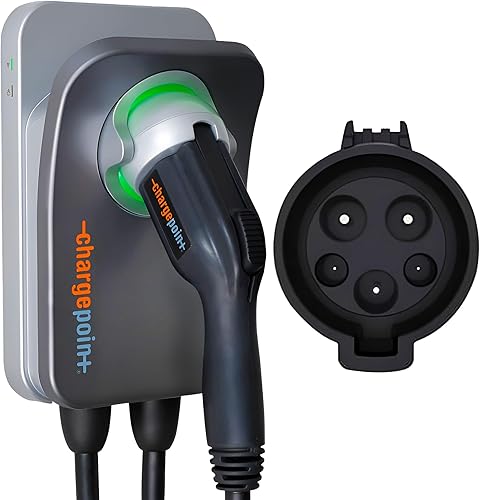
ChargePoint Home Flex
Adjustable 16-50A output, the best app of any third-party charger, and works with every EV. At 50A it delivers 37 mi/hr to the Lightning, enough for overnight charging if you plug in by early evening.
Check it on Amazon →Emporia Pro Level 2
Full 48A charging with WiFi, app control, and energy monitoring. That's far less than the Charge Station Pro. It adds 36 mi/hr, enough to get the Standard Range battery from 15% to full in about 10 hours.
See it on Amazon →Lightning-Capable Chargers in One Table
Every charger below works with the Ford F-150 Lightning. The Lightning uses a J1772 port (2024 and earlier) or NACS (2025+). All chargers listed use J1772, which connects natively to 2024 and earlier models. The Ford Charge Station Pro is the only unit delivering the full 80A the Lightning can accept. Click any column header to sort.
| Charger | Amps | Lightning Speed | Smart | Plug Type | Price | Link |
|---|---|---|---|---|---|---|
| Ford Charge Station Pro | 80A | 48 mi/hr | WiFi, FordPass App | Hardwire Only (100A breaker) | $$$$ | Ford.com |
| ChargePoint Home Flex | 50A | 37 mi/hr | WiFi, App, Alexa, Google | NEMA 14-50 / Hardwire | $$$$ | View |
| Emporia Pro Level 2 | 48A | 36 mi/hr | WiFi, App, Alexa, Google | NEMA 14-50 / Hardwire | $$$$ | View |
| Wallbox Pulsar Plus | 48A | 36 mi/hr | WiFi, Bluetooth, App | Hardwire Only | $$$$ | View |
| Grizzl-E Classic | 40A | 30 mi/hr | None | NEMA 14-50 | $$$$ | View |
Price tiers are approximate. $ = under $50, $$ = $50 to 150, $$$ = $150 to 300, $$$$ = over $300. Tap any link for the current Amazon price.
Lightning Owners on Home Charging
Spec sheets only tell half the story. Here's what shows up repeatedly in verified-purchase Amazon reviews for the third-party chargers in this comparison. Pulled from the top-helpful reviews on each product page as of October 2026. (The Ford Charge Station Pro sells through Ford, not Amazon, so it's not covered here.)
ChargePoint Home Flex (4.3-star verified-buyer average)
The most helpful positive reviews describe thoughtfully engineered hardware that a handy non-electrician can hang on an existing 14-50 outlet. The loudest 1-star feedback is a firmware-frustration story, so budget some patience if you're relying on the app side.
Emporia Pro Level 2 (4.8-star verified-buyer average)
Verified buyers report getting from box to charging in roughly an hour on a pre-existing dryer plug, and long-form reviews describe uneventful set-and-forget service as a daily home EVSE at 40A continuous. The same owners caution that the power cord is thick and resists tight bends, so plan your mounting clearance.
Wallbox Pulsar Plus (4.3-star verified-buyer average)
Verified owners praise the Pulsar Plus for build quality and the NEMA Type 4 weather rating. Top-helpful reviews highlight the assembled-in-USA construction and the Bluetooth+WiFi app for granular scheduling. The trade-off: at 48A this unit is hardwire-only, so you need a licensed electrician (no NEMA 14-50 plug option at full amperage). This is an early-days pick, so the 4.3 is directional.
Grizzl-E Classic (4.6-star verified-buyer average)
Owner sentiment clusters around ruggedness: a heavy steel enclosure that runs cool at full load, and multi-year reports of a charger that has never needed a firmware update because there is nothing to update. For a Lightning owner worried about firmware lock-in, that's the appeal in plain language.
Jacob’s read on this category
The Lightning is the one EV where I take the 80A question seriously, and the answer is still usually no. The Charge Station Pro’s 19.2 kW needs a 100A breaker and a professional hardwire, and forcing 100A onto a typical panel can add a $2,000 to $4,000 upgrade before the charger ever powers on. Against that, 48A already restores about 36 miles of range per hour, which turns a 100-mile workday into under three hours of overnight charging. The 80A install earns its money in two cases: heavy towing on a daily cycle, or wanting the Ford backup-power story; everyone else banks the difference.
Why the F-150 Lightning Is Different
The F-150 Lightning is the most demanding EV you can charge at home. Two specs set it apart from nearly every other electric vehicle on the market, and both directly affect which charger you should buy.
The 19.2 kW onboard charger (2022-2023 Extended Range only)
Every EV has an onboard charger. That's the component that converts AC from your wall unit into DC for the battery. In most EVs, including Ford's own Mustang Mach-E and the Rivian R1T, this onboard charger tops out at 11.5 kW (48 amps at 240V), the class our 48A charger roundup covers. The 2022 and 2023 Extended Range F-150 Lightning's onboard charger is rated at 19.2 kW (80 amps at 240V). That's 67% more than a Tesla Model 3, a Rivian R1T, or a Hyundai Ioniq 5. The Standard Range battery and all 2024 and newer Lightnings carry a 48A (11.3 kW) onboard charger instead, so an 80A unit buys them nothing.
In plain English: the Lightning can charge nearly twice as fast at home as most EVs, but only if your charger can deliver 80 amps. A standard 48A charger hooked up to the Lightning feeds it only about 60% of what it can take. The truck still charges fine. You're just leaving 40% of its charging speed on the table.
The massive battery
The F-150 Lightning comes in two battery sizes: 98 kWh (Standard Range) and 131 kWh (Extended Range). For context, the Tesla Model Y Long Range uses a 75 kWh battery. The Lightning Extended Range packs 75% more energy storage than that.
Battery size directly determines how long a full charge takes. A bigger battery at the same charging rate means more hours plugged in. That's where the Lightning's high-amperage onboard charger is supposed to compensate. Again, only if your charger matches it.
Here's the core tension. The Lightning was built to charge at 80A, but the only home charger that actually delivers 80A is the premium-priced Ford Charge Station Pro, which requires a 100-amp circuit breaker with professional hardwire installation. Every third-party alternative tops out at 40 to 50A, which means longer charge times for a truck that already has a huge battery to fill.
Do You Need an 80A Charger?
This is the most important question for any Lightning owner shopping for a home charger. The answer depends on your battery size, your daily driving, and when you plug in. Let's run the math.
The numbers at 80A (Ford Charge Station Pro)
- Power delivery: 80A × 240V = 19,200W = 19.2 kW
- Range added per hour: ~48 miles
- Standard Range (98 kWh) from 15% to 100%: ~6 hours
- Extended Range (131 kWh) from 15% to 100%: ~8 hours
The numbers at 48A (Emporia, most third-party chargers)
- Power delivery: 48A × 240V = 11,520W = 11.5 kW
- Range added per hour: ~36 miles
- Standard Range (98 kWh) from 15% to 100%: ~10 hours
- Extended Range (131 kWh) from 15% to 100%: ~13 hours
The numbers at 40A (Grizzl-E Classic)
- Power delivery: 40A × 240V = 9,600W = 9.6 kW
- Range added per hour: ~30 miles
- Standard Range (98 kWh) from 15% to 100%: ~12 hours
- Extended Range (131 kWh) from 15% to 100%: ~16 hours
Now look at your daily reality. The average American drives 37 miles per day. Even with the Lightning's lower efficiency (it's a full-size truck, not a sedan), that works out to roughly 50 miles of range consumed daily. At 36 mi/hr from a 48A charger, you recover that in under 90 minutes. You don't need an 80A charger for daily driving.
Where 80A matters: If you regularly drain the Extended Range battery below 30% and need a full charge by morning, a 48A charger takes 13 hours. Plug in at 8 PM and you're not done until 9 AM. The Charge Station Pro does it in 8 hours. Plug in at 8 PM, done by 4 AM. That 5-hour gap is the real value of 80A charging.
Where 48A is fine: If you drive typical daily distances (under 80 miles), you never arrive home truly empty. Recovering 50 to 80 miles of range takes 1.5 to 2.5 hours at 48A. You'll be fully topped off long before morning no matter which charger you own. Spending the extra money on the Charge Station Pro versus the Emporia Pro only pays off if you regularly need fast recovery from deep discharges.
Ford Charge Station Pro vs Third-Party Chargers
The Charge Station Pro is the obvious choice if money and panel capacity aren't concerns. But once you add the cost of a 100A breaker and professional hardwire installation, the total installed cost can reach $2,000 to $2,500. Here's what you get and what you give up at each tier.
Reasons to choose the Ford Charge Station Pro
- Full 80A charging: 48 miles of range per hour. No other home charger gets close. This is the only way to use 100% of the Lightning's onboard charging capability.
- Intelligent Backup Power: Paired with a compatible home integration system, the Charge Station Pro lets the F-150 Lightning power your entire home during an outage. The Extended Range battery holds enough energy to run an average home for about 3 days. No third-party charger does this.
- FordPass integration: The Charge Station Pro connects to the FordPass app, giving you charging schedules, energy monitoring, departure times, and status updates in the same app you already use for the truck itself.
- Built for the Lightning: Ford engineered this charger specifically around the F-150 Lightning's electrical characteristics. The communication protocol between the truck and charger is tuned end-to-end.
Reasons to choose a third-party charger
- Price: The Emporia Pro Level 2 costs far less than the Charge Station Pro. Even after installation, you're looking at $250 to $400 total versus $2,000+ for the Ford unit.
- Electrical panel capacity: The Charge Station Pro requires a 100-amp breaker. Many homes, especially those built before 2000, only have 100-amp or 150-amp main panels. Dedicating 100A to the charger may force a panel upgrade ($2,000 to $4,000). A 48A charger needs only a 60-amp breaker, and a 40A charger needs a 50-amp breaker. Far easier to fit into an existing panel.
- Plug-in installation: The Emporia Pro, ChargePoint Home Flex, and Grizzl-E Classic can all plug into a standard NEMA 14-50 outlet. Already got a dryer-style outlet in the garage? Installation cost is zero. The Charge Station Pro has to be hardwired by a licensed electrician.
- Multi-vehicle compatibility: If your household has a second EV that isn't a Ford, a J1772 charger works with everything. The Charge Station Pro uses J1772 too, but it's an expensive pick just for universal compatibility.
- Portability: Plug-in chargers unplug and come with you. Renters, people who move a lot, or anyone with a second property benefits from not having an expensive unit bolted to one location forever.
Charging Time Comparison
This is the table that matters most for Lightning owners. It shows how long each charger takes to bring the F-150 Lightning from 15% to 100% for both battery sizes. We use 15% as the starting point because that's a realistic "low battery" arrival. Most drivers plug in before hitting single digits.
| Charger | Amps | kW Delivered | mi/hr Added | Standard Range (98 kWh) 15% → 100% |
Extended Range (131 kWh) 15% → 100% |
|---|---|---|---|---|---|
| Ford Charge Station Pro | 80A | 19.2 kW | 48 mi/hr | ~6 hrs | ~8 hrs |
| ChargePoint Home Flex | 50A | 12.0 kW | 37 mi/hr | ~9.5 hrs | ~12.5 hrs |
| Wallbox Pulsar Plus | 48A | 11.5 kW | 36 mi/hr | ~10 hrs | ~13 hrs |
| Emporia Pro Level 2 | 48A | 11.5 kW | 36 mi/hr | ~10 hrs | ~13 hrs |
| Grizzl-E Classic | 40A | 9.6 kW | 30 mi/hr | ~12 hrs | ~16 hrs |
The gap between the Charge Station Pro and everything else is stark. At 80A, the Ford charger finishes the Extended Range battery 5 hours faster than a 48A charger and 8 hours faster than a 40A unit. For the Standard Range battery, the gap is smaller but still real: 6 hours versus 10 to 12.
Notice that ChargePoint at 50A and Wallbox at 48A are only barely faster than the 48A Emporia. At most about 30 minutes on a full charge. All three sit in the same $$$$ tier, so the choice comes down to ChargePoint's app and adjustable amperage, Wallbox's hardwire-only NEMA 4 enclosure, or the Emporia's bundled load management, which matters most on a panel a Lightning is already taxing.
The Grizzl-E at 40A starts to struggle with the Extended Range battery. Sixteen hours from 15% to 100% means you need to plug in by 3 PM to be done by 7 AM. Workable for some people. Tight for most. We wouldn't recommend a 40A charger for Extended Range Lightning owners unless you rarely discharge below 40%.
Which Charger Should You Get?
After comparing every Lightning-compatible home charger, here are our specific picks for the situations F-150 Lightning owners actually face.
Frequently Asked Questions
How We Picked These for the Lightning
The Lightning's 19.2 kW onboard charger drove the whole shortlist for this one. Very few home chargers can hit 80A, so I treated the Ford Charge Station Pro as the only true "full-speed" option and built the rest of the list around the 48 to 50 amp band, which is where most Lightning owners actually land once they see what a 100A panel circuit costs. Third-party prices and stock were re-checked against the current Amazon listings on October 17, 2026. Each product got checked against its top-helpful verified reviews before I wrote about it.
No manufacturer paid for placement here, and we do not take review units. If something flunks the battery-size math for a 131 kWh Extended Range truck, the recommendations say so.