Quick answer: the receptacle decides, not the charger. NEC 625.54 is written about receptacles that serve EV equipment, so a plug-in charger on a NEMA 14-50 puts the question squarely in front of your inspector, while a hardwired unit takes the receptacle out of the conversation. If you want the shortest path through a permit, hardwire the Wallbox Pulsar Plus 48A. If the outlet is already on the wall and you want to keep it, the NexCyber Level 2 48A is the plug-in to put on a properly protected circuit.
Where This Lands for a Home Install

Wallbox Pulsar Plus 48A
The 48A model is hardwired, rated NEMA Type 4 for indoor or outdoor mounting, and listed to UL 2594 and UL 2231 with an integrated 20 mA charge current interrupting device plus ground monitoring. Premium tier, and the install that gives an inspector the least to argue with.
See it on Amazon →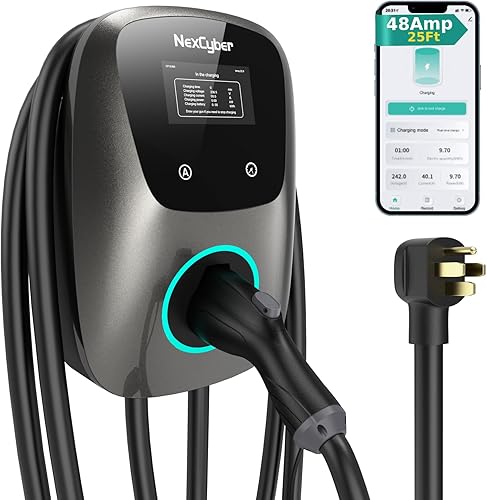
NexCyber Level 2 48A
ETL listed, J1772, a 25-foot cable and a NEMA 14-50 plug, at a mid-tier price well under the hardwired units. The trade is that the receptacle it plugs into is exactly the thing the code language is aimed at.
Check it on Amazon →Two 48A Chargers, Two Different Inspections
Both units deliver the same 48A on a 240V circuit. What separates them for this question is the connection method, which is what decides whether a receptacle rule is in play at all.
| Charger | Amps | Connection | Connector | Listing | 625.54 receptacle rule | Price | Link |
|---|---|---|---|---|---|---|---|
| Wallbox Pulsar Plus 48A | 48A | Hardwired | J1772 | UL 2594, UL 2231 | Not a receptacle install | $$$$ | View |
| NexCyber Level 2 48A | 48A | Cord and plug | J1772 | ETL listed | Applies to the outlet it uses | $$$ | View |
Price tiers are approximate. $ = under $50, $$ = $50 to 150, $$$ = $150 to 300, $$$$ = over $300. Tap any link for the current Amazon price.
What the Code Language Actually Covers
Article 625 is the EV section of the National Electrical Code, and 625.54 is the part people quote at each other. Read it carefully and it is about receptacles: an outlet installed to serve EV charging equipment is the subject, not the charger hanging on the wall. That is why the answer to this question changes depending on how the unit is connected rather than which brand you bought.
Wallbox states the practical version of that in its own North American documentation. In the Pulsar Plus installation guidance the company says that for a hardwired installation an additional GFCI breaker is optional under article 625.54. A manufacturer saying the breaker is optional is not the same as an inspector saying it, but it tells you the hardwired path is the one the equipment was designed around.
The second rule is the one that catches people out. Section 210.8 carries its own ground-fault requirements tied to location and circuit rating, and recent code cycles widened the garage and accessory-building language. A hardwired charger can still be swept in by 210.8 even though 625.54 does not reach it. Jurisdictions also adopt different code editions and write their own amendments, so the honest answer to "do I need one" always ends with the electrician who pulls your installation permit.
There is live movement here too. A Tentative Interim Amendment has been proposed that would require GFCI protection for all EV charging receptacles, with public comment closing in May 2026, and the industry group CharIN filed an appeal over the 2026 revisions to the same article. Trade coverage of the proposed amendment lays out how unsettled the receptacle question still is. If you are specifying a charger you expect to keep for a decade, that uncertainty is itself an argument for hardwiring.
Why Stacking Two Protections Causes Nuisance Trips
Every listed Level 2 charger already contains ground-fault detection. On the Pulsar Plus it is an integrated charge current interrupting device that opens at about 20 milliamps, with ground monitoring, certified under UL 2231. That device exists to protect the vehicle connection, and it is deliberately set above the leakage a healthy charging cable produces.
A personnel GFCI is a different animal entirely. It opens in the 4 to 6 milliamp band, because that is the threshold set to protect a human body. Put one upstream of a charger that is designed to tolerate leakage up to 20 milliamps and you have two devices watching the same circuit with thresholds a factor of four apart. The charger shrugs; the breaker opens.
In practice the trips cluster around conditions that raise normal capacitive leakage: a long charging cable coiled on a damp floor, an outdoor or below-grade receptacle, a cold wet morning, a vehicle inlet that has been rained on. Nothing is faulty. The breaker is simply doing exactly what it was built to do, on a circuit where the charger already handles the job at a different threshold. Our walkthrough on what to check when a charger keeps tripping the breaker covers how to tell this pattern apart from a genuine wiring fault, which matters because the two look identical from the garage door.
The point worth taking away: the charger's internal device is not a substitute for a GFCI and an inspector will not treat it as one. A 20 milliamp CCID and a 6 milliamp GFCI protect different things. Arguing that the charger "already has GFCI" is the fastest way to fail an inspection.
Hardwire or Plug In: Which Fight Do You Want
Hardwiring removes the receptacle, and with it the rule written about receptacles. It also removes the weakest mechanical link in a plug-in install, since a NEMA 14-50 outlet carrying 40 amps continuously for hours every night is working harder than the dryer outlet it looks like. The cost is flexibility: moving the charger later means an electrician, not a plug.
Cord-and-plug keeps that flexibility and lets you install the charger yourself if the outlet already exists and is wired correctly. The trade is that you inherit the receptacle rule, you may be buying a two-pole GFCI breaker on top of the charger, and you are relying on an outlet whose quality varies enormously between brands. We go deeper on that decision in the NEMA 14-50 versus hardwired comparison.
One detail that catches first-time buyers: a 48A charger cannot run at 48A through a NEMA 14-50. A 50A circuit allows 40A continuous under the 80 percent rule, so a plug-in 48A unit is dialed down to 40A on that outlet. Getting the full 48A means a 60A circuit and, on most units, a hardwired connection. Our guide to breaker sizing for a 48A charger has the arithmetic, and the wider Level 2 charger roundup puts both of these units next to the rest of the field.
What Installers and Buyers Keep Reporting
Spec sheets do not capture how these installs behave once they are live. Here is what recurs in electrician forum threads and in verified-purchase feedback for the two units here, retold in our own words rather than quoted.
Wallbox Pulsar Plus 48A
The hardwire requirement is the single most common surprise in buyer feedback. People order the 48A model expecting to plug it into an existing 240V outlet, find no plug in the box, and have to book an electrician they had not budgeted for. Beyond that first shock the recurring themes are positive about the enclosure and the compact footprint. Treat the hardwire step as part of the purchase, not an afterthought, and the complaint disappears.
NexCyber Level 2 48A
Buyers consistently single out the onboard display for setting amperage without reaching for a phone, which matters more than it sounds when you are dialing a plug-in unit down to match a 50A circuit. It is a newer listing from a less established brand than the European and North American incumbents, so weigh the feedback accordingly and check the current listing before you commit.
The GFCI trip thread that never ends
Across electrician forums the same scenario repeats: a plug-in charger on a GFCI-protected circuit that trips intermittently, usually in wet or cold conditions, with no fault ever found. The resolutions that stick are almost always the same two, a hardwired conversion or a correctly specified breaker on a properly sized dedicated circuit. Swapping the charger rarely fixes it, because the charger was never the problem.
Jacob’s read on this question
The GFCI argument is really a proxy for a decision people make too casually: plug-in or hardwired. Plug-in feels cheaper and reversible, and for a 32A charger on a short run it often is. At 40A continuous, every night, for years, the receptacle becomes the part of the system most likely to degrade, and it is also the part that drags a contested code section into your permit. If the circuit is being run new anyway, the incremental cost of terminating into the unit instead of into an outlet is small, and it buys a quieter inspection and one fewer connection to fail. Keep the plug-in route for the garage that already has a healthy outlet and a charger you genuinely expect to move.
Which One Fits Your Install
Choose the Wallbox Pulsar Plus 48A if the circuit is being run new, if the charger is going outdoors or on a below-grade garage wall, or if you simply want the version of this install with the fewest open code questions. It is hardwire-only, NEMA Type 4 rated, and carries UL 2594 and UL 2231 listings. Budget for the electrician from the start.
Choose the NexCyber Level 2 48A if a correctly wired NEMA 14-50 is already on the wall, you want to keep the option of unplugging and taking the charger with you, and you accept running at 40A on that circuit. It is ETL listed with a 25-foot cable and sits a full tier below the hardwired units on price. Confirm with your electrician whether the receptacle needs GFCI protection under the code edition your area has adopted before you buy a breaker.
FAQ
How These Two Were Selected for a Code Question
This page needed one charger that can only be hardwired and one that can only be plugged in, because that is the fork the code language turns on. The Wallbox Pulsar Plus 48A and the NexCyber Level 2 48A match on output, connector and vehicle compatibility and differ on exactly the variable being tested, which keeps the comparison honest. Connection method, enclosure rating and safety listings were taken from the manufacturers' own current datasheets and installation documentation; the code reading was drawn from the published article text, trade reporting on the proposed amendment, and electrician forum discussion of how inspectors apply 625.54 and 210.8 in practice.
Amazon listings were re-checked against this site's audit records on 2026-10-26. No manufacturer paid for placement, and no review units were supplied. Nothing on this page is a substitute for a licensed electrician confirming the code edition and local amendments in force where you live.
Prices and availability reflect Amazon listings at time of writing. Confirm on the product page before purchase.